
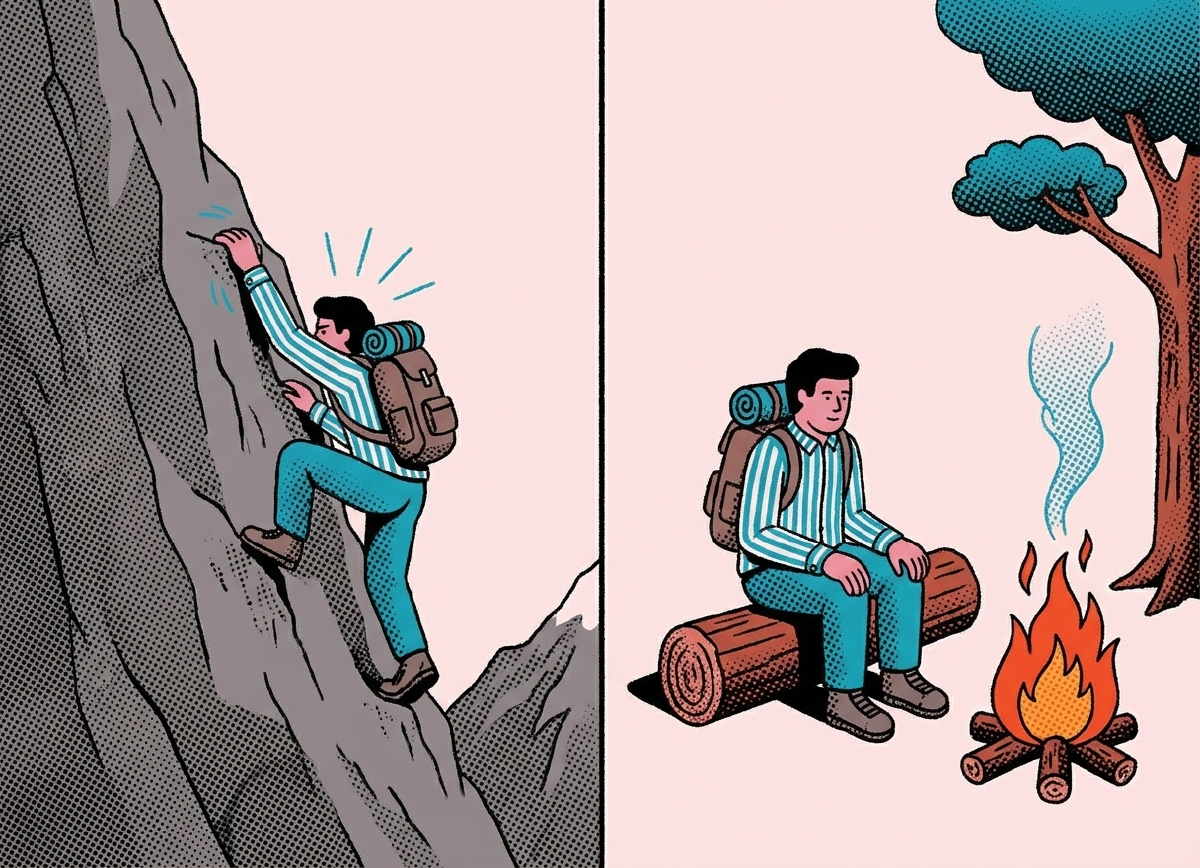

I stood in the lobby of a bank on a Tuesday afternoon.
I had just deposited a check that represented the biggest single sale of my career up to that point. It was a number I had written down on a piece of paper three years prior. It was the goal. It was the summit.
I walked out to my car, sat in the driver’s seat, and waited for the wave of euphoria to hit me.
It never came.
Instead, I felt a strange, hollow panic. My brain had already skipped over the victory and was obsessing over the tax implications, the delivery schedule, and the terrifying question of how I would replicate this next quarter.
This is the curse of the entrepreneur. We are wired for the pursuit, not the capture.
We are told that we need to stay hungry. We are told that satisfaction is the enemy of progress. Yet, we are also told to practice gratitude and mindfulness.
How do we reconcile these two opposing forces? Can you be relentlessly ambitious and deeply content at the same time? Or is one always the thief of the other?
To build something that lasts without burning out, we have to understand the mechanics of this paradox.
The Biology of Dissatisfaction
#It is important to understand that your inability to stay satisfied is not a character flaw. It is a survival mechanism.
Neuroscience tells us that dopamine is not the molecule of pleasure. It is the molecule of more.
Dopamine is released during the anticipation of a reward, not the receipt of it. From an evolutionary standpoint, this makes perfect sense. If our ancestors sat around feeling perfectly content after one meal, they would have starved. The biological drive to seek more resources, more security, and more status kept them alive.
In a modern business context, this drive builds empires. It pushes us to iterate on the product one more time. It forces us to make the cold calls. It keeps us up late fixing the code.
However, when left unchecked, this mechanism creates a phenomenon known as the hedonic treadmill.
You achieve a goal. Your brain releases a spike of dopamine. You feel good for a moment. Then, your brain adapts to this new baseline. You return to your default level of happiness, but now you need a bigger win to get the same chemical hit.
The hunger is never satiated. It just scales.
If we do not intervene in this cycle, we risk spending our entire careers chasing a horizon that moves away from us at the exact speed we run toward it.
Distinguishing Complacency from Contentment
#The primary fear most founders have regarding gratitude is that it will make them soft.
We conflate contentment with complacency.
Complacency is the state of ignoring problems. It is a refusal to improve. It is saying that the status quo is good enough because we are too lazy or frightened to change it. Complacency destroys businesses.
Contentment is different. Contentment is an acceptance of reality without the emotional turbulence. It is the ability to look at what you have built and recognize its value, even while you plan to expand it.
We need to separate our operational ambition from our existential worth.
Operational ambition says, “This product has a flaw, and I am going to fix it because I care about quality.”
Existential dissatisfaction says, “This product has a flaw, therefore I am a failure and I will not be happy until it is perfect.”
The former builds better companies. The latter builds miserable founders.
We can be fiercely critical of our output while remaining grateful for the opportunity to play the game.
The Gap and The Gain
#There is a concept in psychology that explains why high achievers are often the unhappiest people in the room.
It is the difference between measuring forward and measuring backward.
Most ambitious people measure themselves against an ideal. This ideal is a fantasy of where they think they should be.
“I should be at ten million in revenue.” “I should have fifty employees.” “I should be on the cover of that magazine.”
Because the ideal is a moving target, you are always in the “gap.” You are constantly measuring the distance between where you are and where you want to be. This gap is filled with anxiety and feelings of inadequacy.
The alternative is to measure the “gain.”
Look backward. Where were you twelve months ago? What problems were you facing then that would seem trivial to you now? What skills have you acquired?
When you measure backward, you are dealing with concrete facts. You can see the progress. This generates a sense of competence and momentum.
This is not about resting on your laurels. It is about fueling your tank.
Ambition burns a lot of energy. If you only focus on the gap, you are driving on fumes. Recognizing the gain refuels the psychological tank so you can press on.
The Conditional Happiness Trap
#We often fall into the trap of conditional living.
“I will be happy when we close the round.” “I will relax when we hire a COO.” “I will take a vacation when we hit profitability.”
This is a contract you make with yourself to be unhappy in the present in exchange for a future that may never arrive.
In business, there is no “there.” There is no finish line where the confetti drops and the problems stop.
If you sell the company, you have a new set of problems regarding identity and wealth management. If you go public, you have shareholders breathing down your neck. If you stay small, you worry about cash flow.
The problems change, but the stress remains constant unless you change your relationship to it.
We have to learn to enjoy the solving of the problem, rather than just the elimination of it. The friction of business is not an interruption to your life. It is your life.
If you cannot find a way to enjoy the chaos of building, you will not enjoy the silence of having built.
Calibrating the Balance
#So how do we practically apply this? We need to create a dual operating system.
Imagine a dial. One side is “Hunger” and the other is “Gratitude.”
Most of us think we have to choose one setting. In reality, we need to adjust the dial depending on the context.
During a strategy session or a product sprint, turn the hunger up. Be critical. Be demanding. Look at the deficiencies in your business and attack them with vigor. This is the time for dissatisfaction.
But when you walk out of that office, or when you sit down for dinner with your family, you must manually turn the dial back to gratitude. You must look at the fact that you have the agency to build a business at all.
You have to recognize that the stress you feel is a privilege. You chose this path.
This requires a level of mental discipline that is harder than reading a spreadsheet. It requires you to catch yourself in the middle of a complaint and reframe it.
Are you stressed because you are overwhelmed with orders? That is a good problem.
Are you anxious because you have to fire someone? That means you have a team to manage.
Are you tired because you worked all weekend? That means you have a purpose that drives you.
The Infinite Game
#Ultimately, the goal of the entrepreneur should not be to win the game, because the game never ends. The goal is to keep playing.
If you run solely on hunger, you will eventually break down. The machinery of your mind will seize up from the friction.
If you run solely on contentment, you will stop moving and the market will pass you by.
We need the hunger to start the engine, but we need the gratitude to cool it down.
It is possible to want more for your future while simultaneously loving your present. It is a difficult balance to strike, but it is the only way to build something remarkable without losing yourself in the process.
Stay hungry. Be grateful.
Keep building.