

You hit send on the cold email.
You make the cold call.
You pitch the investor.
And then you hear it. The word that every founder dreads. The word that feels like a physical blow to the stomach.
“No.”
Or perhaps it is the polite version: “Not a fit right now.” Or the silent version: being ghosted.
Your brain immediately spirals. You think, “My product is bad. I am bad at sales. This company is going to fail.”
This reaction is biological. We are social animals wired to seek acceptance from the tribe. Rejection triggers the same neural pathways as physical pain.
But in the context of building a startup, this biological response is a liability.
If you treat every “no” as a personal failure, you will burn out in six months. The emotional tax is too high.
To survive, and to thrive, you must fundamentally rewire your relationship with rejection. You must stop viewing it as a verdict on your worth and start viewing it as data on your market.
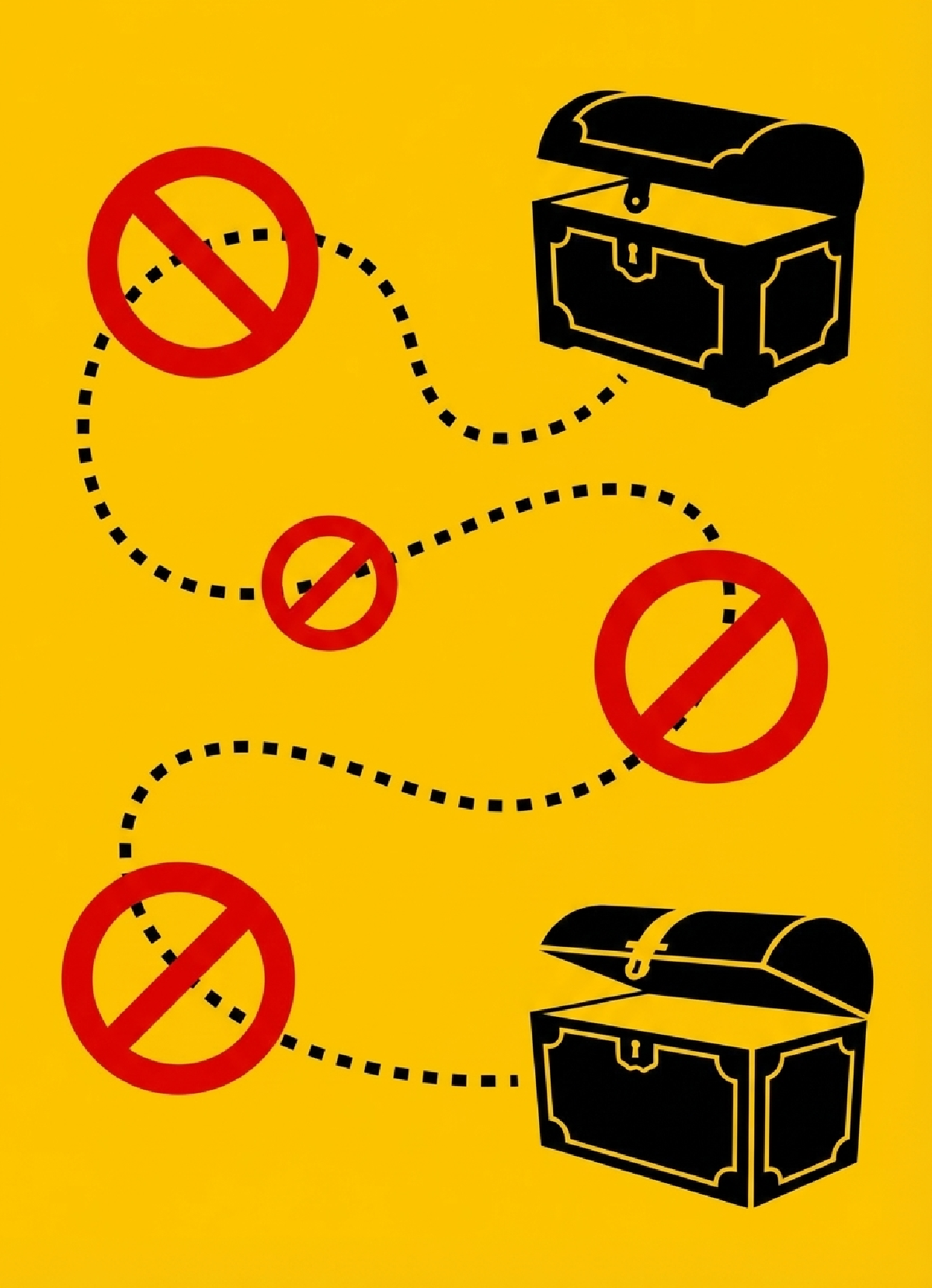
A “no” is not an endpoint. It is a coordinate on a map.
Read Jim Camp’s excellent book, “Start with No” while in your despair. It’ll really help.
The Law of Large Numbers
#The first step in reframing rejection is understanding the math.
Sales is a funnel. At the top, you pour in leads. At the bottom, customers fall out. In between, there is a massive amount of leakage. This is normal.
Even the best salespeople in the world have close rates of 20 or 30 percent. That means they fail 70 percent of the time.
When you are a founder, your close rate might be 1 percent or 5 percent in the early days. That means you have to hear “no” ninety-five times to hear “yes” five times.
If your hit rate in 1% that means you need at least 100 attempts to see that rate. Giving up on number 20 or 30 just means you never got enough data… low hit rates can be depressing. Keep pushing through.
If you take each of those ninety-five rejections personally, you will quit before you reach the ninety-sixth call.
You have to depersonalize the process. You are a scientist running an experiment. Each call is a trial. A “no” is simply a null result. It adds to your dataset.
When you look at it this way, you can actually gamify it. You can set a goal for rejections. “I want to get fifty ’no’s’ this week.”
By inverting the goal, you remove the fear. You are hunting for the “no” because you know that statistically, the “yes” is hiding behind it.
The “Why” Beneath the No
#The most valuable part of rejection is the reason behind it.
But most founders never hear the reason because they are too busy retreating to lick their wounds.
When someone says no, your instinct is to hang up or say “thanks anyway” and leave. Fight that instinct.
Stay in the pocket. Ask a follow-up question. Not to argue, but to understand.
“I completely understand. Just for my own learning, was it the price, the timing, or did I miss the mark on the feature set?”
Often, the prospect will be disarmed by your lack of defensiveness. They will tell you the truth.
- “Honestly, we just signed a contract with a competitor last week.” (Timing issue).
- “We don’t have the budget for this right now.” (Price issue).
- “We really need an integration with Salesforce, and you don’t have it.” (Product issue).
This is gold.
If you hear the Salesforce objection ten times in a row, you know exactly what to build next. The market has just given you your roadmap.
You paid for that roadmap with your ego. That is a cheap price for product-market fit.
The Wrong Room Theory
#Sometimes, the product is fine, and the pitch is fine, but you are in the wrong room.
Imagine trying to sell a steak to a vegan. You can have the best steak in the world. You can have the best sales pitch in the world. The answer will still be no.
Does that mean the steak is bad? No.
It means you have a targeting problem.
Many early-stage rejections are simply a result of bad targeting. You are pitching enterprise software to small businesses. You are pitching a consumer app to B2B investors.
When you get a “no,” ask yourself: Is this person actually my Ideal Customer Profile (ICP)?
If the answer is no, then their rejection is irrelevant. It is noise. You should discard it from your dataset.
But if they are your ICP and they still say no, then you have a signal. You need to adjust the product or the messaging.
The Emotional Callus
#There is a physical component to this. You have to build a callus.
The first time you cold call, your heart races. Your voice shakes. The rejection stings for days.
The hundredth time, your pulse doesn’t move. You hang up and dial the next number immediately.
This is not becoming cynical. It is becoming professional.
A surgeon does not cry every time they see blood. If they did, they couldn’t operate. They have developed a professional detachment that allows them to be effective.
You need to develop that same detachment towards the commercial viability of your interactions. You care about the person, but you are neutral about the outcome.
This neutrality is actually attractive. Desperation smells. When you need the “yes” too badly, the prospect senses it and pulls away. When you are indifferent to the outcome because you trust your process, you project confidence.
The Pivot Point
#There is a danger in resilience. You can be too resilient.
If you bang your head against a wall for three years and the wall doesn’t move, you are not being gritty. You are being delusional.
You need to distinguish between the “Soft No” and the “Hard No.”
A Soft No is, “Not right now.” Or, “It’s too expensive.” These are objections that can be overcome or waited out.
A Hard No is silence. Or apathy. Or a consistent pattern of feedback that says, “This problem is not painful enough for me to pay you to solve it.”
If you pitch 100 qualified prospects and get 100 rejections, the market is screaming at you.
Listen to it.
This is where the data becomes actionable. You don’t just keep dialing. You pivot. You change the offering. You change the price. You change the customer segment.
The rejection saved you from building a product nobody wants.
Just to repeat. If you expect a low hit rate you need A LOT of data points to make any decisions. That is emotional taxing. Pay the tax.
The Archive of Resilience
#Every successful founder has a graveyard of rejections.
- Airbnb was rejected by almost every major investor. The founders sold cereal boxes to survive.
- JK Rowling was rejected by twelve publishers.
These stories are clichés, but they are true. The difference between the people you read about and the people you don’t is often just the ability to endure the “no” long enough to find the “yes.”
Keep a “Rejection Archive.”
Save the emails. Write down the dates. Not to hold a grudge, but to measure your journey.
One day, you will look back at those emails from the other side of success. You will realize that those rejections were not roadblocks. They were guardrails.
They kept you from working with the wrong partners. They forced you to refine your pitch. They made you stronger.
So pick up the phone.
Send the email.
Invite the rejection.
It is the only way to find out where you stand.