
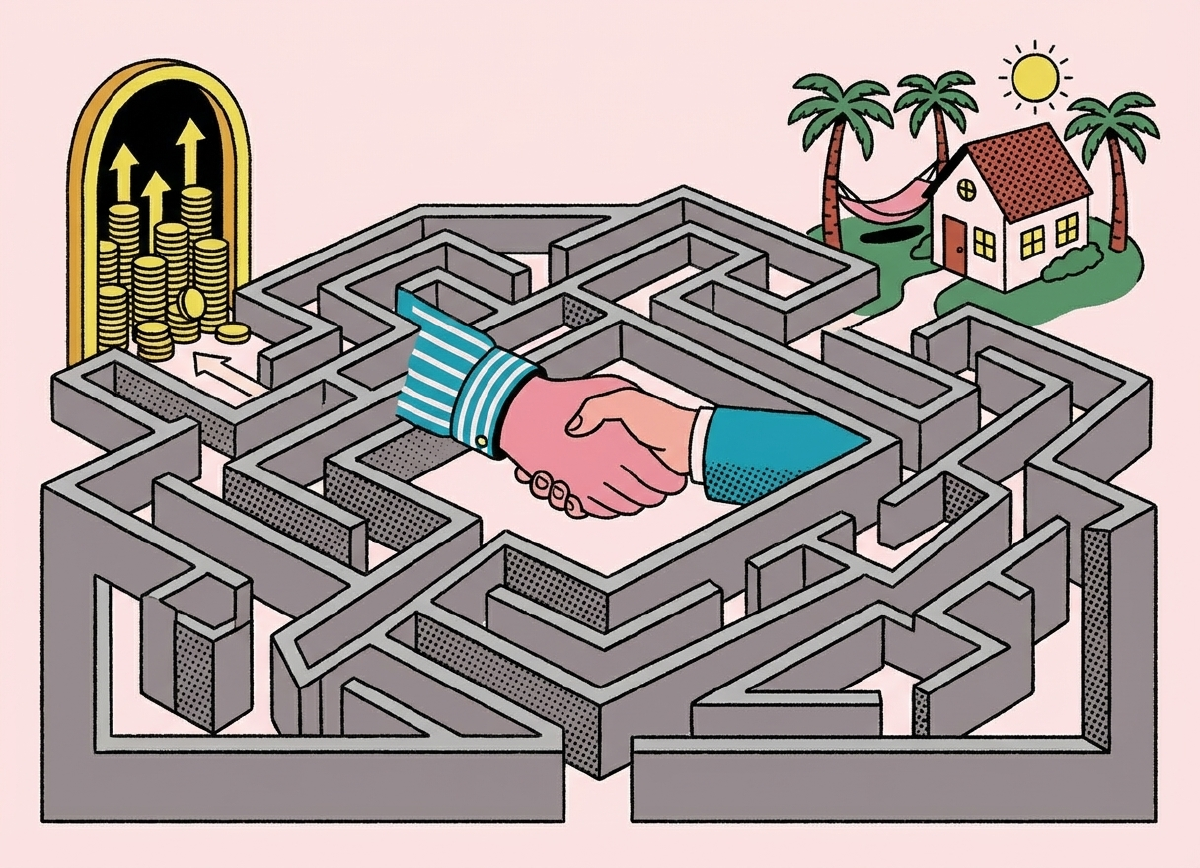

You are sitting in a pitch meeting with an investor.
They ask you a simple question: “What is the exit strategy?”
You freeze.
You stumble. You mumble something about an IPO in seven years. Or maybe you say, “We are focused on building a great company right now.”
The investor nods politely, but you can see the light go out in their eyes.
They know you haven’t thought about it.
Most founders treat the “exit” as a dirty word. They think talking about selling the company means they are not committed to the mission. They think it means they are just in it for the money.
But this is a fundamental misunderstanding of business mechanics.
An exit strategy is not about quitting. It is about design.
You cannot build a house if you do not know if you are building a cottage or a skyscraper. The foundation is different. The materials are different. The zoning permits are different.
If you do not know where you are going, every road looks like the right road. And that is how you end up driving in circles until you run out of gas.
The Three Doors
#There are really only three ways a startup ends.
Door Number One: The Lifestyle Business. You own it forever. It pays you a massive salary. You pass it down to your kids. This is a valid, noble, and often lucrative path.
Door Number Two: The Acquisition. You build it to a certain size, and then a bigger fish eats you. This is the most common “success” outcome for venture-backed startups.
Door Number Three: The IPO. You go public. You ring the bell. This is the rarest outcome, reserved for the 0.01 percent of outliers.
You have to pick a door. Today.
Why?
Because each door requires a different vehicle.
If you want Door Number One, you should not raise Venture Capital. VCs need an exit to pay their LPs. If you never sell, they never get paid. They will force you to sell or fire you.
If you want Door Number Two, you need to build strategic value for a specific set of buyers. You need to know who those buyers are before you write a line of code.
If you want Door Number Three, you need to build a governance structure and a growth engine capable of surviving the scrutiny of the public markets. That requires a level of rigor that kills speed in the early days.
Reverse Engineering the Buyer
#Let’s assume you want to be acquired. This is the most pragmatic goal for a tech startup.
Who buys you?
Is it a competitor who wants your market share? Is it a platform that wants your technology? Is it a private equity firm that wants your cash flow?
These are different buyers with different motivations.
If you are building for a competitor, your metric is market share. You need to be annoying enough that it is cheaper to buy you than to fight you.
If you are building for a platform (like Salesforce or Google), your metric is integration value. You need to solve a specific problem for their users better than they can.
If you are building for Private Equity, your metric is EBITDA (Earnings Before Interest, Taxes, Depreciation, and Amortization). They do not care about your “vision.” They care about your margins.
Once you identify the likely buyer, you can tailor your roadmap. You can build the features they lack. You can attend the conferences they attend. You can hire the people they respect.
You are essentially grooming the company for a specific marriage.
The Valuation Gap
#One of the biggest reasons deals fail is a mismatch in valuation expectations.
Founders often value their company based on “potential.” Buyers value companies based on “proof.”
Or worse, founders value their company based on how much money they raised. “We raised at a ten million dollar valuation, so we must be worth at least that.”
That is not how it works.
The market determines the price. And the market for acquisitions is often colder than the market for fundraising.
To prepare for an exit, you need to understand the multiples in your industry. If SaaS companies are trading at 5x revenue, and you have $1 million in revenue, you are worth $5 million. It does not matter if you think you are the next Uber.
Knowing this math early prevents you from raising too much money. If you raise $5 million at a $20 million valuation, but the market cap for your type of business is only $15 million, you have “over-raised.”
You have priced yourself out of an exit. You can no longer be sold for a win. You have to swing for a home run or die trying.
The Operational Clean-Up
#We discussed Due Diligence in a previous article, but it bears repeating in the context of strategy.
An exit is a transfer of risk.
The buyer is taking on your risk. If your risk is high, the price is low.
Strategic exit planning involves systematically de-risking the business.
Do you rely on one client? That is a risk. Fix it.
Is your IP undocumented? That is a risk. Fix it.
Is your team likely to quit the day after the sale? That is a risk. Fix it with vesting schedules and culture.
The cleaner the company, the higher the multiple. A boring, predictable company is worth more than a chaotic, exciting one to a buyer.
The Emotional Detachment
#Perhaps the hardest part of the exit strategy is psychological.
You have to love the business enough to build it, but be detached enough to sell it.
If your identity is entirely wrapped up in being the “CEO of X,” you will sabotage the deal. You will find reasons to say no. You will fight over petty terms because you are not ready to let go of the baby.
You have to view the business as a product. It is something you built, but it is not you.
Start thinking about your “Next Act” long before you sell. What will you do the day after? Will you become an investor? Will you start a non-profit? Will you just sleep for six months?
Having a vision for your post-exit life gives you the courage to pull the trigger when the offer comes.
The Optionality of Profit
#The ultimate exit strategy is actually not needing to exit.
If you build a profitable, sustainable business that generates cash, you have infinite leverage.
You can sell if the offer is great. You can keep running it if the offer is low. You can hire a CEO and become the Chairman.
Desperation destroys value. If you have to sell because you are running out of cash, the buyer will smell blood in the water. They will lowball you. They will add onerous terms.
But if you are profitable, you can walk away. And the ability to walk away is the strongest negotiating position in the world.
So, go back to that investor meeting in your head.
When they ask, “What is the exit strategy?”
Do not mumble.
Look them in the eye and say, “We are building a product that is strategically aligned with the roadmap of “Buyer A” and “Buyer B”. Based on current multiples, we see a clear path to a “X” return in five years. However, our primary goal is to reach profitability so we can control the timing of that exit.”
That is the answer of a founder who knows where they are going.
And that is the founder who gets funded.