
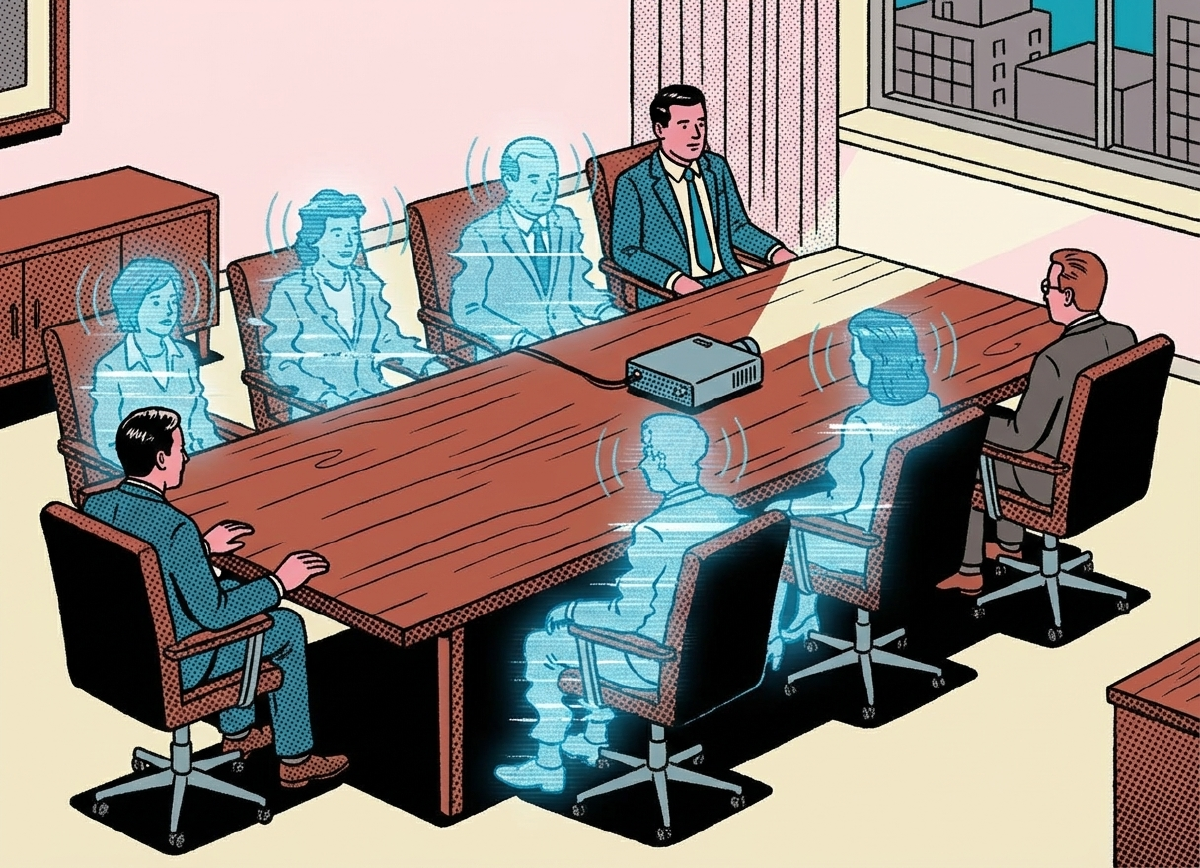

You are sitting in a conference room.
Three of your key team members are sitting around the table with you. The other two are projected on a TV screen on the wall. The audio is slightly delayed.
Someone in the room makes a joke. The three people at the table laugh. The two people on the screen stare blankly because the microphone did not pick it up. By the time they realize a joke was made, the moment has passed.
Then the meeting ends.
You and the in-person crew walk out of the room and head toward the coffee machine. On the way there, you discuss the project you just met about. A decision is made right there in the hallway.
The two people on the screen have already logged off. They do not know the decision was made. They are operating on old information.
This is the hybrid trap.
We often think of hybrid work as the “best of both worlds.” We assume it offers the flexibility of remote work with the cultural glue of in-person work. But for a founder, it is often the worst of both worlds.
It creates a structural friction that is invisible to the people in the office but painfully obvious to the people at home.
If you do not manage this dynamic with extreme intention, you will accidentally build a two-tier company. You will have the “inner circle” who are physically present, and the “outer circle” who are merely observing.
And eventually, the outer circle will leave.
The Science of Proximity Bias
#To understand why this happens, we have to look at human psychology.
There is a cognitive distortion known as Proximity Bias. It is the unconscious tendency to give preferential treatment to those in our immediate vicinity.
Evolutionarily, this makes sense. We trust the people we can see. We bond with the people we break bread with. The person sitting next to you feels more “real” than the avatar on Slack.
In a business context, this bias is toxic.
It means that the person who comes into the office gets the promotion, not because they are better, but because they were there when you needed to vent about a client. It means the person in the office gets the cool project because you saw them in the kitchen and remembered to ask them.
This destroys meritocracy.
It signals to your remote employees that their output matters less than their physical location. It tells them that the only way to advance in your organization is to pay for a commute.
We have to ask ourselves a hard question.
Are we building a culture where the best ideas win, or a culture where the loudest voice in the room wins?
If you are a founder who prefers being in the office, you are the biggest risk factor. Your gravity distorts the company. Where you are is where the power is.
The Asymmetry of Information
#The friction in hybrid teams is usually caused by information asymmetry.
In an all-remote team, everyone is forced to communicate via text or video. The playing field is level. In an all-in-person team, everyone is in the room. The playing field is level.
In a hybrid team, the playing field is tilted.
Information flows fluidly in the office through osmosis. You overhear conversations. You see body language. You sense the mood of the room.
Remote employees only get the information that is explicitly packaged and sent to them.
This creates the “Meeting After the Meeting” phenomenon. The official meeting happens on Zoom. But the real meeting happens when the laptops close. The in-person group debriefs, vents, and strategizes. They realign without telling the remote folks.
Three days later, the remote employee delivers work based on the Zoom call, only to be told that the direction changed.
They feel gaslighted. They feel incompetent. But they are neither. They are just unconnected.
The Digital First Rule
#So how do you fix this without forcing everyone back to the office or firing your local team?
You have to adopt a “Digital First” operating system.
The rule is simple but annoying. If one person is remote, everyone is remote.
This means that even if four of you are in the same conference room, you all bring your laptops. You all log into the Zoom call individually. You all wear headphones.
This sounds ridiculous. It feels awkward to look at a screen when the person is sitting three feet away.
But it is necessary.
It gives the remote employee the same pixel real estate as the CEO. It ensures that everyone hears the audio at the same volume. It prevents the side conversations that exclude the digital participants.
Furthermore, you must move decision-making out of the hallway and into the document.
If a decision is made at the coffee machine, it does not exist. You must force a culture of writing. The decision must be posted in Slack or the project management tool before it is ratified.
This slows you down. That is the cost.
Writing takes longer than talking. But writing scales. Talking evaporates.
By forcing all decisions into the written record, you create a history that anyone can access, regardless of their time zone or location. You democratize the context.
The Erosion of Junior Talent
#There is a variable in remote work that we are still trying to understand.
Senior employees often thrive in remote settings. They know the job. They have the network. They just want to execute without distraction.
Junior employees are struggling.
Learning a trade often happens through observation. It happens by swiveling your chair and asking, “Hey, how do I handle this?” It happens by listening to the founder take a sales call.
In a hybrid environment, the remote junior employee is isolated. They are terrified to send a Slack message because it feels like an interruption. They spin their wheels for hours on a problem that could be solved in two minutes.
If you have a hybrid team, you must over-index on mentorship for remote staff.
You cannot rely on osmosis. You have to schedule the osmosis.
This might look like “co-working hours” where a video channel is left open just for hanging out. It might look like recording your sales calls and doing a breakdown session later.
You have to manufacture the moments that used to happen by accident.
The Rituals of Connection
#Culture is not ping pong tables. Culture is the shared set of values and the rituals that reinforce them.
In a hybrid team, you cannot rely on the Friday happy hour. If you have a party for the office crew, you are actively alienating the remote crew.
You need rituals that are location-agnostic.
Maybe it is a synchronous wins-of-the-week meeting. Maybe it is a book club. Maybe it is an annual retreat where you fly everyone in.
The retreat becomes non-negotiable in a hybrid setup. You need to bank interpersonal credits. Humans are biological. We need to see each other in three dimensions occasionally to build the trust that sustains us through the two-dimensional months.
Spend the money on the flight tickets. It is cheaper than recruiting new staff.
The Future of the Office
#This leads us to reconsider the purpose of the office itself.
If you are hybrid, the office is no longer a factory where work gets done. It is a clubhouse where relationships are built.
Don’t force people to come in just to sit on Zoom calls all day. That breeds resentment. If they are coming in, it should be for collaboration, for whiteboarding, for socializing.
We must also accept that this is harder than the alternatives.
Running a fully remote company is hard. Running a fully in-person company is hard. Running a hybrid company is the hardest of all because you are maintaining two distinct cultures and trying to bridge them.
You will fail at times. You will accidentally leave someone out. You will suffer from proximity bias.
The goal is not perfection. The goal is awareness.
When you feel yourself leaning toward the person in the room, catch yourself. When you make a decision in the hallway, stop and write it down.
Your business is an entity that exists in the cloud, not in the building. The building is just one of many interfaces.
Ensure the interface works for everyone.