

You are sitting in a coffee shop with a potential customer.
You have your laptop open. You are walking them through the demo. You are hitting every talking point. You are showing them the features that took your team six months of sleepless nights to build.
The customer is nodding.
They are smiling.
At the end of the meeting, they say, “This is really interesting. You guys have built something very cool.”
You leave the meeting feeling energized. You go back to the team and tell them that the meeting went great. You put the prospect in your CRM with a 90 percent probability of closing.
But they never buy.
They stop replying to your emails. They ghost you.
This happens once. Then it happens ten times. Then it happens fifty times.
You are stuck in the “Friend Zone” of business. Everyone is nice to you. Everyone thinks your product is “cool.” But nobody is willing to trade their hard-earned money for it.
This is the most dangerous phase of a startup.
It is dangerous because it is not a clear failure. If everyone hated your product and told you it was garbage, you would know you need to change. But the politeness of the market gives you false hope.
You tell yourself you just need one more feature. You tell yourself you just need better marketing. You tell yourself that success is just around the corner.
But deep down, in the quiet moments of the morning, you know the truth.
The idea is not working.
This is the moment that defines you as an entrepreneur. Do you double down on a losing hand, or do you have the courage to pivot?
The reason we stay in the zombie phase for so long is a cognitive glitch known as the Sunk Cost Fallacy.
We value things based on how much effort we have put into them, not on what they are worth to the world.
You look at your codebase. It represents thousands of hours of logic. It represents weekends missed and family dinners skipped. To delete it feels like admitting that those hours were wasted. It feels like setting money on fire.
So you keep building on top of it. You try to fix a structural problem with cosmetic additions.
But the market does not care about your effort. The market is a ruthless, efficient pricing machine. It only cares about value.
If you spent two years building a machine that solves a problem nobody has, the value of that machine is zero.
To pivot, you have to divorce your ego from your output. You have to accept that the code is not the asset. The team is the asset. The insight is the asset. The code is just a liability that you are currently servicing.
Once you accept that the work you did is “sunk” and cannot be recovered, you are free to make a rational decision about the future.
The Signals of Apathy
#How do you know for sure that it is time to pivot?
You look for apathy.
Hate is not the opposite of love in business. Indifference is.
If customers are complaining about bugs, that is good. It means they are trying to use the product. It means they care enough to be angry.
If customers are silent, you are dead.
Look at your retention metrics. Are people signing up, logging in once, and never coming back? That is apathy.
Look at your sales cycle. Are you having to drag people across the finish line with discounts, constant follow-ups, and begging? If you have to convince someone that they have a bleeding neck wound, they probably do not have a bleeding neck wound.
True product-market fit feels like a pull, not a push. The market pulls the product out of you. Customers ask for billing details before you even ask for the sale.
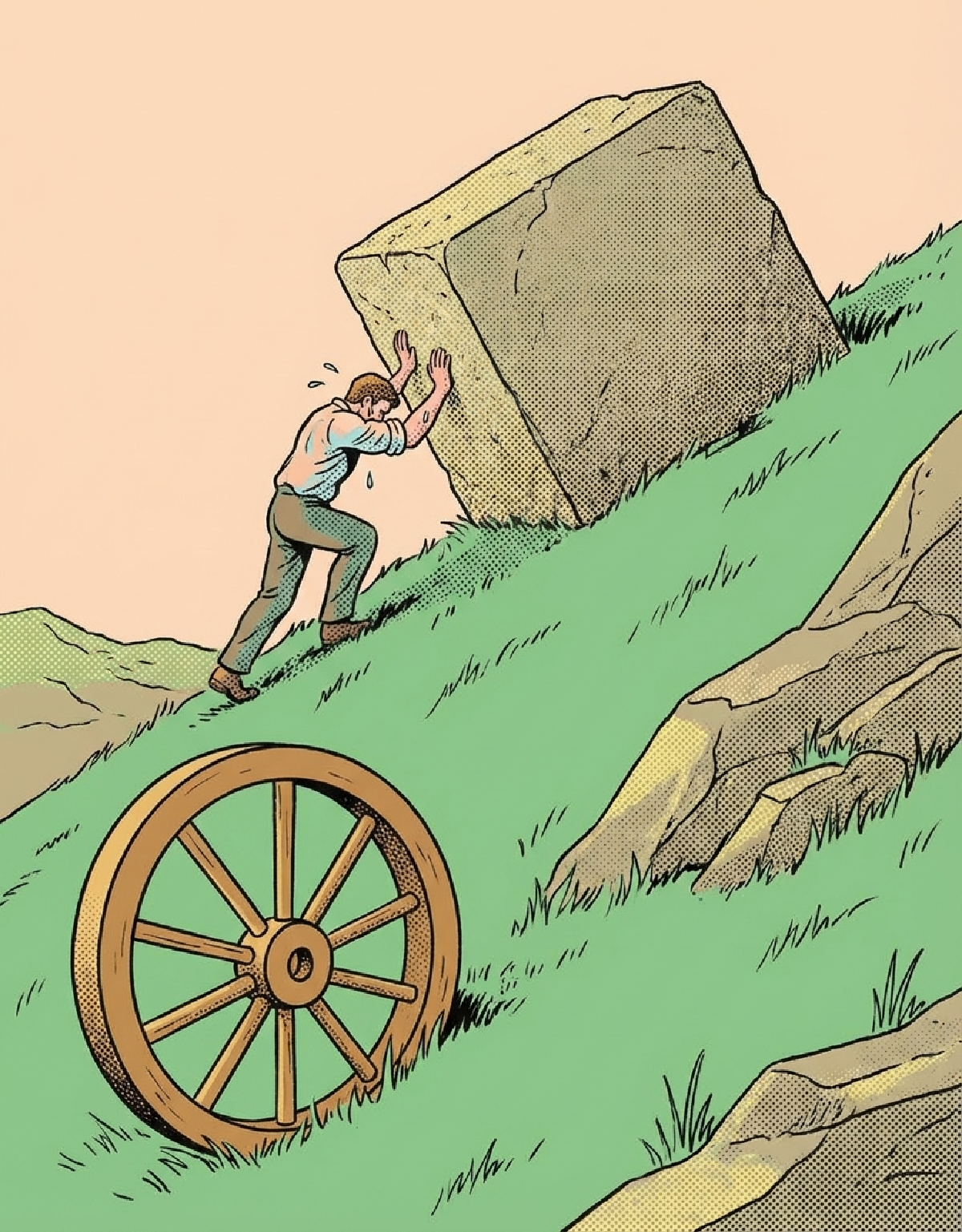
If you have been pushing a boulder uphill for twelve months and it rolls back down the moment you stop pushing, you do not have product-market fit.
You have a heavy boulder.
The Anatomy of a Pivot
#A pivot is not a restart.
If you fire everyone and start a new company in a totally different industry, that is not a pivot. That is a shutdown and a new launch.
A pivot is a change in strategy without a change in vision. It is keeping one foot planted while moving the other foot to a new position.
Eric Ries, the author of The Lean Startup, categorized several types of pivots. The most common for struggling startups is the “Zoom-In Pivot.”
This happens when you realize that your product does ten things, but your customers only care about one of them.
Maybe you built a complex project management suite, but everyone just uses the chat feature. The pivot is to kill the suite and focus entirely on building the best chat tool in the world.
This is what happened to Slack. They were building a video game. The game failed. But the internal chat tool they built to talk to each other while building the game was excellent. They zoomed in on the chat tool. The rest is history.
The opposite is the “Zoom-Out Pivot.” This is when you realize your product is just a single feature of a much larger product that the customer needs.
Then there is the “Customer Segment Pivot.” This is where you realize the product is right, but you are selling it to the wrong people. Maybe your tool is too complex for small businesses but perfect for enterprise. Or vice versa.
Managing the Human Cost
#The hardest part of a pivot is not the code. It is the people.
Your team joined you to build a specific vision. They poured their hearts into that vision. When you stand up at the all-hands meeting and say, “We are scrapping the app and building something else,” you risk a mutiny.
They will feel whipped. They will feel like their work was meaningless. They will lose trust in your leadership.
You have to manage this narrative with extreme care.
You cannot frame it as a failure. You must frame it as a discovery.
Use the scientific method. “We had a hypothesis that the market wanted X. We ran the experiment. The data came back negative. But in the process, we discovered a new anomaly. The data suggests the market actually wants Y.”
Show them the data. Do not make it about your gut feeling. Make it about the market reality.
Even with the best communication, some people will quit. That is inevitable. Some people are builders who love a specific domain. If you pivot out of that domain, they will leave.
Let them go with grace. You need a team that is aligned with the new direction, not mourning the old one.
The Runway Reality
#There is a mathematical constraint to pivoting.
Money.
A pivot resets your traction. You are going back to square one on revenue, but your burn rate remains high because you still have a team and overhead.
You have to calculate your remaining runway. Do you have enough cash to execute the pivot and find traction before you die?
If you have three months of cash left, a complex pivot is suicide. You do not have the time. You might need a “lifeboat” pivot—something small and cash-flow positive immediately.
If you have twelve months of cash, you have the luxury of a strategic pivot. You can do customer development. You can build prototypes.
This is why you must pivot early. The longer you wait in the zombie phase, thinking things will get better, the less runway you have to execute the turn.
Waiting is expensive.
The Relief of Alignment
#There is a secret that founders who have successfully pivoted rarely talk about.
The relief.
The moment you admit the old idea is dead, a massive weight lifts off your chest. You stop pretending. You stop selling a lie to yourself and your investors.
Suddenly, the energy returns. The team gets excited about a new problem. You are no longer trying to force a square peg into a round hole.
You are building something that might actually work.
Business is an iterative process. It is messy. It is nonlinear. The straight line from idea to IPO is a myth told in retrospect.
Your initial idea was likely wrong. That is statistically probable. It was just a starting point to get you into the arena.
Now that you are in the arena, look around. Listen to the crowd. See what they actually want.
And have the courage to build that instead.