
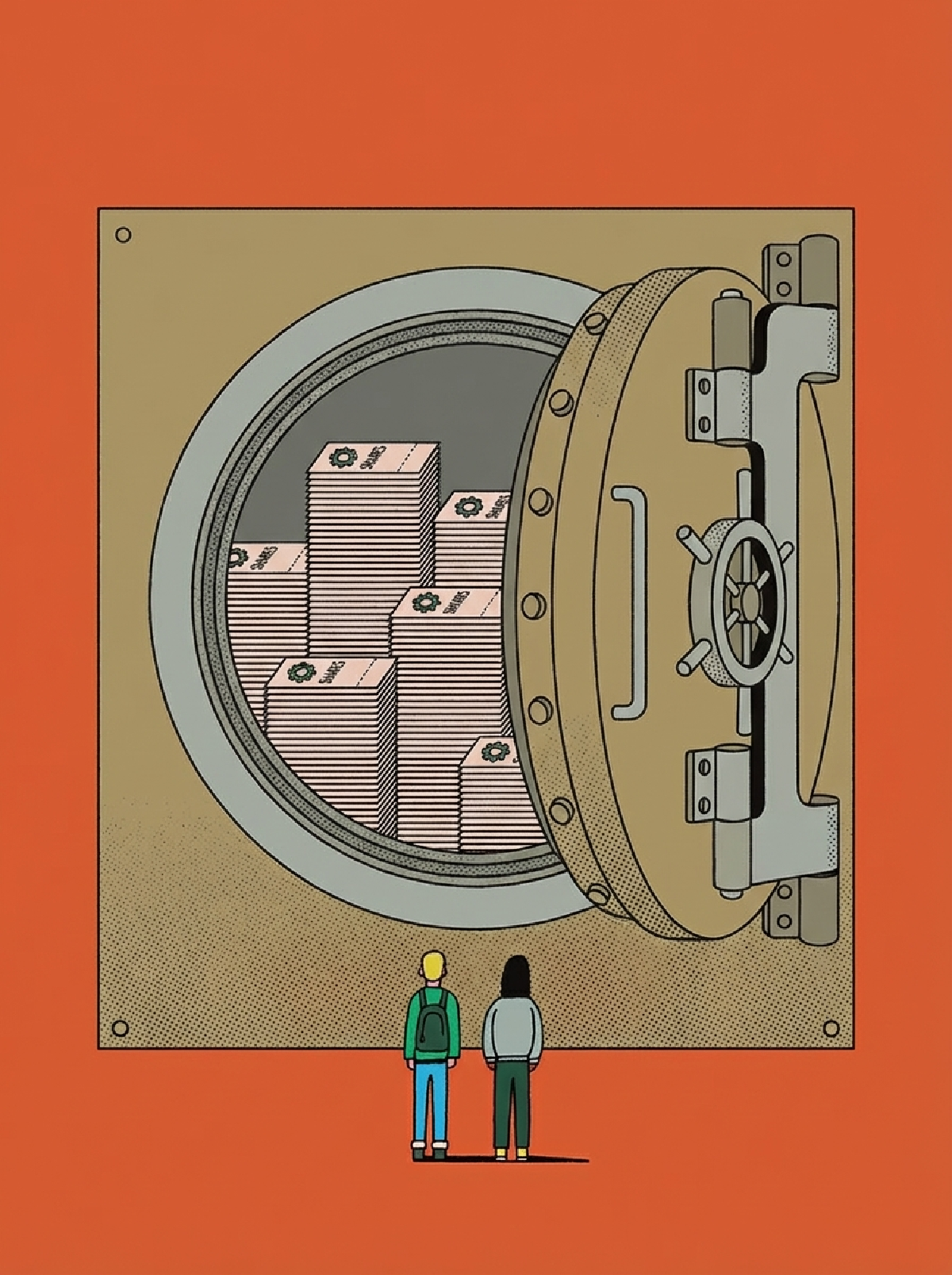

The Mechanics of the Imaginary Box
#You are sitting in a room with a lawyer. Or maybe you are just staring at a document on your laptop screen that costs five hundred dollars to file.
You are about to incorporate.
People talk about equity constantly in the startup world. They talk about points and percentages and basis points. They talk about it like it is a gold rush.
But very few people stop to explain what is actually happening mechanically when you create equity.
Most founders treat equity like a fixed pie that they have to carve up. They worry about giving away too much too soon. They worry about being left with nothing.
These are valid fears.
But to conquer them, you need to stop looking at equity as money. You need to stop looking at it as a reward.
You have to start looking at equity as a piece of machinery.
Because that is exactly what a corporation is. It is a machine we build to hold value. And equity is the control panel for that machine.
The Legal Fiction
#Let’s start with the basics of the corporation itself.
When you incorporate, you are bringing a new person into existence.
The law treats a corporation as a distinct legal entity. It can own property. It can sue people. It can be sued. It has rights and it has responsibilities.
But it is invisible. It has no physical body.
So how do we interact with this invisible person?
We use shares.
Think of the corporation as an empty box. When you file your Articles of Incorporation, you are building the box.
Right now, the box is empty. It owns nothing. It has done nothing.
To make the box useful, you have to put things inside it. You put your intellectual property in it. You put money in it. You put your time and effort in it.
In exchange for putting these valuable things into the box, the box gives you a receipt.
That receipt is a share of stock.
This is the fundamental transaction of equity. It is an exchange. You give the corporation value. The corporation gives you a claim on that value.
Authorized vs. Issued
#This is where the mechanics get interesting.
When you file your paperwork, you have to decide how many shares the corporation is allowed to create.
This is called “Authorized Shares.”
Imagine a book of blank certificates. If you authorize 10,000,000 shares, you have a book with ten million blank pages.
Most startups authorize 10,000,000 shares.
Why?
Because it is a large enough number that you can give small pieces to people without dealing with messy fractions. It is psychological.
But here is the catch.
Just because you authorized 10,000,000 shares does not mean you own 10,000,000 shares.
Those shares do not exist yet. They are just potential. They are blank pages in the book.
To make them real, the board of directors (that is you, usually) has to formally “issue” them.
When you issue a share, you tear the page out of the book. You write a name on it. You hand it to someone.
This distinction is critical.
If you authorize 10,000,000 shares but only issue 100 shares to yourself, you own 100% of the company.
The other 9,999,900 shares are irrelevant for ownership percentage. They are just sitting in the treasury, waiting to be used.
Ownership is calculated based on the issued shares, not the authorized shares.
This is a concept that trips up many first-time founders. They think if they authorize more shares, they are diluting themselves.
They aren’t.
You only dilute yourself when you issue those shares to someone else.
Buying Your Own Company
#So you have your box. You have your book of blank certificates.
Now you want to be the owner.
You have to buy your shares.
This sounds strange. Why would you pay for a company you just invented?
Because the corporation is a separate person. It cannot just give you things for free. That would be tax fraud or a weird legal gray area.
So you set a price.
Usually, this price is extremely low. It is called the “par value.” It is often $0.00001 per share.
If you issue yourself 4,000,000 shares at a par value of $0.00001, you write the company a check for $40.
Now you legally own those shares. You have a cost basis.
This is the mechanic that allows you to make money later. You bought the stock for nearly nothing. If the company becomes valuable, the stock is worth a lot. The difference is your capital gain.
But there is a danger here.
If you do not pay for your stock, or if you do not document that purchase, the IRS might come along later and say you received that stock as income when it was worth millions.
Then you owe taxes on millions of dollars you do not have in cash.
That is a disaster.
The mechanics matter. You have to write the check. You have to sign the Stock Purchase Agreement. You have to make the paper trail real.
The Time Component
#Now you own the shares. But the corporation needs to protect itself.
What if you quit tomorrow?
If you walk away with 50% of the company, the company is dead. No investor will touch it. Your co-founders will be furious.
So we introduce a new mechanic called Vesting.
Vesting is a restriction on the shares you just bought.
You legally own the shares. You have voting rights. You get dividends if there are any.
But the company has the right to buy them back from you if you leave.
Usually, this right fades away over time.
The standard is a four-year vest with a one-year cliff.
For the first year, the company can buy back 100% of your shares if you leave. You effectively own nothing permanently.
On the 366th day, the “cliff” passes. Suddenly, 25% of your shares are yours forever. The company cannot touch them.
Every month after that, a tiny slice more becomes yours.
This aligns the mechanics of the equity with the reality of the work.
Startup success takes time. The equity structure must reflect that time commitment.
It protects the entity from the humans running it.

The Pie Does Not Stay the Same Size
#We often use the pie analogy for equity. If you take a slice, there is less for me.
That is true for a fixed moment in time.
But a corporation is designed to grow.
When you take investment, you are not giving the investor your shares. You are usually not selling the shares you bought for $40.
Instead, the corporation goes back to that book of blank certificates.
It issues new shares.
Let’s say you and your co-founder own 8,000,000 shares together. You own 100% of the issued stock.
An investor comes in. They want 20% of the company.
The corporation issues 2,000,000 new shares and sells them to the investor for $1,000,000.
Now there are 10,000,000 shares total.
You still own your original shares. You have not lost a single share.
But your percentage has dropped. You used to own 50%. Now you own 40%.
This is dilution.
It sounds bad. Nobody wants to own less of something.
But look at the mechanics of value.
Before the investment, you owned 50% of a box that had $40 in it.
After the investment, you own 40% of a box that has $1,000,000 in it.
The mechanics of the corporation allow you to trade percentage for capital. You shrink your slice of the pie, but the pie itself gets massive.
This is the engine of startup wealth.
Why This Matters
#You might be thinking that this is all just paperwork. You have lawyers for this.
But understanding the mechanics changes how you make decisions.
When you understand authorized vs. issued shares, you stop worrying about running out of equity. You can always authorize more (with shareholder approval).
When you understand vesting, you stop worrying about a co-founder running off with the company. You have a mechanical process to solve that dispute.
When you understand dilution, you stop hoarding percentage points and start looking for ways to increase the value of the whole entity.
The corporation is a tool.
It is a machine designed to aggregate resources, protect owners, and facilitate investment.
If you don’t understand how the machine works, you are just a passenger.
But if you understand the gears and the levers, you are the operator.
And in the startup world, the operators are the ones who win.