
The Two Analysts
#Imagine two new analysts, both smart, both eager. Let’s call them Sarah and David. On their first day, you hand them access to the same powerful AI tool. It can read a thousand pages of dense financial reports and spit out a perfect executive summary in thirty seconds.
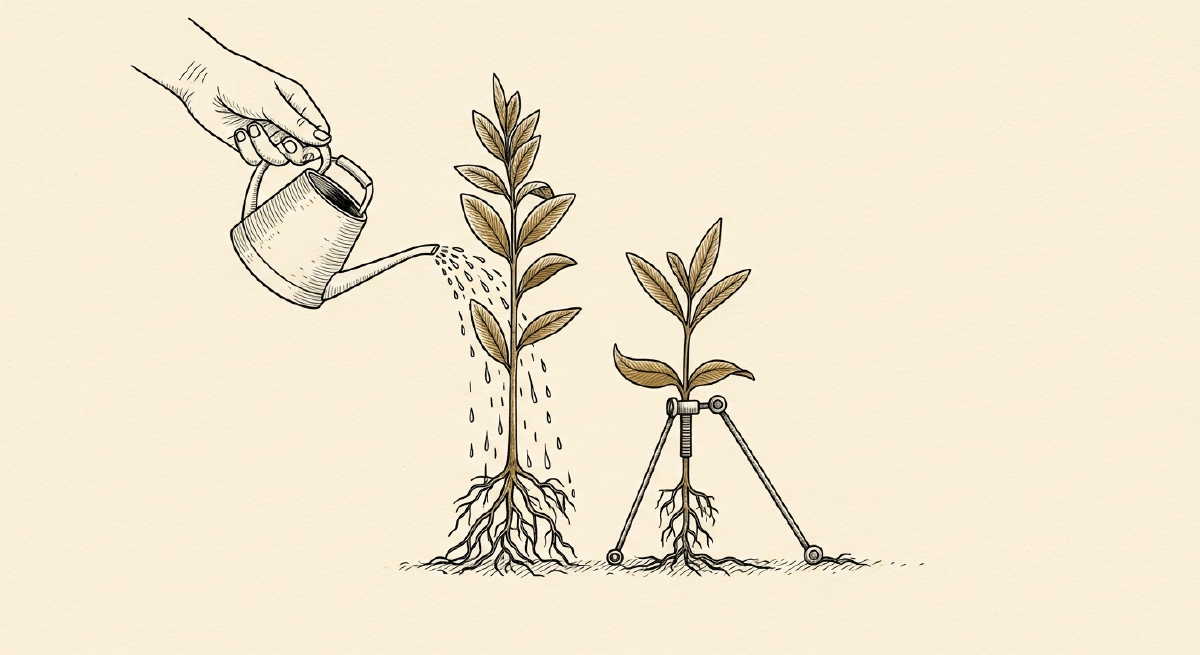
Sarah uses the tool as a partner. She writes her own summary first, struggling through the jargon and the numbers. Then she runs the AI’s version. She compares the two. She looks for what she missed, where the AI found a connection she didn’t. She argues with it, rephrases its sterile prose, and uses the contrast to sharpen her own thinking. The work is still hard. It just moves faster.
David uses the tool as a vending machine. He feeds it the documents and gets a summary. It looks good. It’s fast. He ships it. His manager is happy with the turnaround time. David is happy to be so productive. He does this again and again.
Six months pass.
Sarah is now one of your sharpest thinkers. She can walk into a meeting, having read the pre-brief, and hold her own with the veterans. She has internalized the patterns of a good analysis. She rarely needs the AI for the core task anymore, though she still uses it for esoteric research or to check for blind spots. She is dramatically more capable.
David can no longer do his job without the tool. If the Wi-Fi goes down, he’s useless. He’s gotten very good at writing prompts, but he hasn’t gotten any better at analysis. His output is high, but his actual skill is a flat line. He’s a high-speed operator of a black box.
This is the augmentation gap. It’s the widening chasm between the people who use AI to get better and the people who use it to avoid the work of getting better. And as a leader, the most important question about AI is no longer “should we use it,” but which side of this gap your team is on.
When Productivity Becomes a Crutch
#The story we’re told about AI at work is a story about productivity. Bolt it on, and the numbers go up. Reports get written faster. Code gets generated instantly. Invoices get processed without a human touching them. And on a spreadsheet, this looks like an unqualified win.
But productivity is not capability.
A team that is only productive, and not capable, is brittle. It’s a beautifully fast car with a tiny gas tank, running on fumes.
The myth is that the work is the output. But the real work, the work that builds skill, is the struggle. It’s the reps. It’s the frustrating, messy, human process of wrestling with a problem until you understand it. Every time you remove a rep, you remove a learning opportunity. The AI that gave David the summary also took from him the chance to learn how to synthesize information himself.
It’s the paradox of practice. The very things that make a task difficult are often the things that make it valuable for learning. We’ve known this for decades. A calculator is a wonderful tool for an engineer, but a disastrous one for a third-grader just learning multiplication. Giving them the tool too early doesn’t just help them get the answer. It prevents them from ever learning the method.
We are now handing out calculators for everything. And we are calling it progress.
Learning Velocity and the Half-Life of a Skill
#This doesn’t mean AI is the enemy. It just means we need a better frame. The right question for any leader is not if your team uses AI, but how. Does it accelerate learning, or does it enable coasting?
This brings us to two useful ideas.
Learning velocity is the speed at which a person or team converts new information into durable, usable capability. Sarah had high learning velocity. The AI gave her instant feedback, a tireless sparring partner. It allowed her to get more high-quality reps in less time, so she got better, faster.
Training half-life is the rate at which a skill decays without practice. David is experiencing a catastrophic shortening of his training half-life. Because he never practices the core skill of analysis, his ability to do it atrophies. He becomes dependent on the tool, a human wrapper for an API call. His knowledge is shallow and perishable.
Used correctly, AI is one of the most powerful tools we have for increasing learning velocity. Used incorrectly, it’s a systematic way to hollow out the capability of your entire organization, one task at a time.
Why Effort Still Matters
#
This isn’t just a philosophical point. It’s grounded in biology and in practice.
Before I built companies, I was a scientist. I spent my PhD in bioengineering putting people in brain scanners, trying to understand how the brain’s networks communicate. One thing I came away certain of: learning is not a download. It is a physical, biological process of building and strengthening connections between neurons.
And what drives that process? Effortful retrieval. The act of trying to pull information out of your own head is the signal that tells the brain, “This is important. Keep it. Make it faster next time.” Roediger and Karpicke have shown this directly: people who quiz themselves on material remember far more of it later than people who just reread it, even when the re-readers spend much more time on the page. Pulling the answer out beats putting it back in. When you watch an answer appear on a screen, none of that happens. The struggle is not a bug. It is the entire feature.
After my PhD, I spent over a decade building AI companies in the real world. My first company, RoadBotics, used machine vision to help governments figure out which roads to fix. We sold it to Michelin. The through-line of my entire career has been a single, simple belief: technology should augment human intelligence, not replace it. It should make people more capable, more insightful, and ultimately, harder to replace. Not easier.
An AI that just gives you the answer makes you easier to replace. An AI that helps you learn how to find the answer yourself makes you indispensable.
The One Question to Ask Before You Deploy AI
#So what does this mean for you, the leader trying to navigate this? It means your job has changed. You are no longer just a manager of tasks and timelines. You are now the chief curator of your team’s reps.
Before you roll out any new AI tool, before you automate any process, you have to ask one question:
Which reps does this remove?
And the crucial follow-up:
Are those the reps that build the skill we actually need?
Sometimes, the answer is great. Automating the tedious work of copy-pasting data between spreadsheets? Fantastic. That removes a rep that builds zero valuable skill. Let the machine do the toil.
But what about an AI that writes the first draft of every email for your new sales rep? This removes the reps of thinking about the customer, of finding a hook, of structuring an argument. It removes the very practice that turns a rookie into a closer. You may see a short-term bump in email volume, but you are quietly destroying your talent pipeline.
The goal is to keep the human in the loop for the hard parts. The judgment, the synthesis, the creative leap, the empathetic connection. Use AI to handle the rest. Let it be the research assistant, the brainstorming partner, the tireless simulator. But never let it be the thing that does the thinking.
The Work Ahead
#This isn’t a solved problem. We are all in the early days of a massive, uncontrolled experiment on human capability. The augmentation gap is widening every day, in every company. On one side are the teams and individuals compounding their skills at a dizzying rate. On the other are those who look productive on a chart but are one software update away from obsolescence.
The choice of which side your team lands on is being made right now, in the small decisions you make about the tools you adopt and the workflows you design. It’s happening whether you are paying attention or not.
I write about this often, and we are exploring these questions in a series of essays here. If this is the work you’re doing, you can follow my thinking on LinkedIn as I try to figure it out in public. The stakes are too high to get it wrong.