
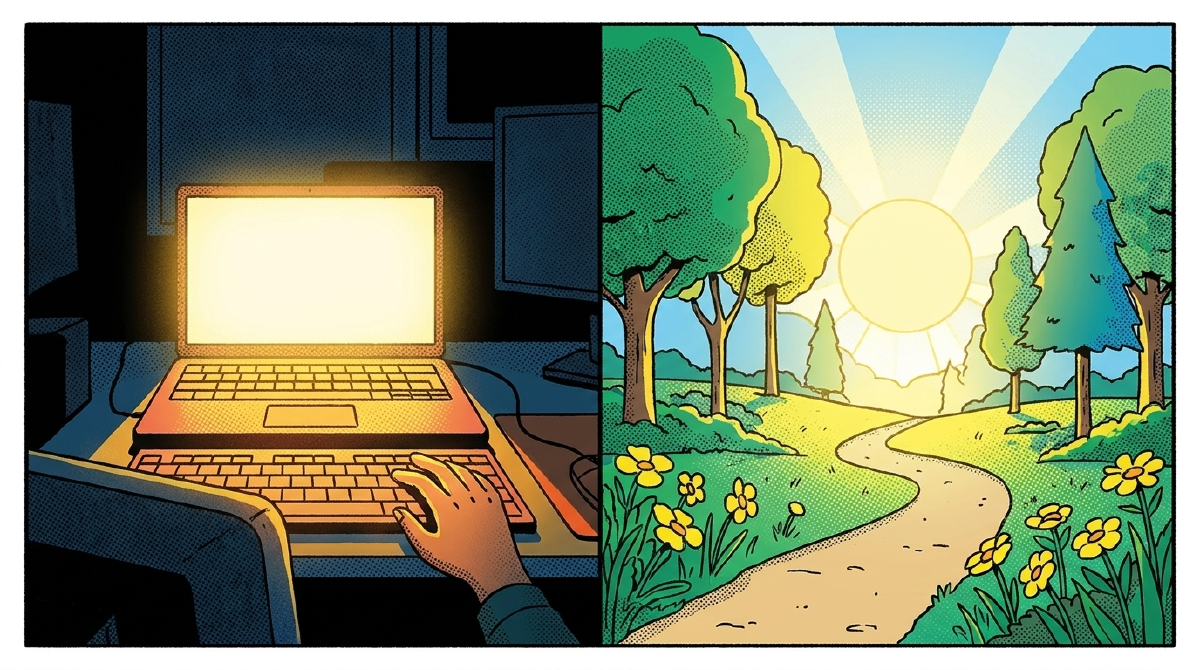

You check the bank account one last time before bed. It is a habit you developed early on when the runway was measured in weeks instead of months. The numbers look stable today, but your heart is still beating a little too fast. You close the laptop, turn off the lights, and lie down. But sleep does not come.
Your mind is already solving tomorrow’s supply chain problem.
I remember a specific night sitting in my car after a fourteen hour day. The engine was off. I just stared at the steering wheel. I was too tired to go inside the house, but my brain was running at full capacity. I was trying to solve a cash flow problem that had no immediate solution. I did not realize what was happening inside my nervous system. I would not understand the damage until months later when my body finally forced me to stop.
We hear the word burnout constantly in the startup ecosystem. It is thrown around in pitch meetings and founder retreats as if it is a badge of honor. We assume it just means being very tired. But science paints a very different picture of what is actually happening to us.
The Biology of the Grind
#When you start a business, you step into an environment of constant ambiguity. Your brain is a prediction machine. It wants to know exactly what will happen tomorrow. When it cannot predict the future, it interprets that ambiguity as a physical threat.
This triggers your sympathetic nervous system. Your adrenal glands release cortisol and adrenaline. Your blood pressure rises. Your focus narrows. This is a highly effective biological mechanism if you are running away from a predator. It is a disastrous mechanism if you are trying to write code or design a long term product strategy.
Chronic stress occurs when that biological alarm never turns off. Founders often live in this state for years.
The scientific literature on chronic stress shows that prolonged exposure to high cortisol levels physically alters the brain. It shrinks the prefrontal cortex, which is the area responsible for complex decision making and impulse control. It enlarges the amygdala, making you more reactive and fearful.
Your biology ignores your company valuation.
When we look at it through this lens, preventing burnout is not about taking a spa day. It is about actively managing your neurochemistry so you retain the cognitive capacity required to run a company.
Engineering Hard Boundaries
#To regulate this biological response, founders need to engineer friction into their lives. We spend all of our time trying to remove friction for our customers. We need to intentionally build it back into our own routines to create boundaries.
A boundary is simply a system.
It is a set of rules that separates your identity as a founder from your identity as a human being. Consider implementing these specific types of boundaries:
- Temporal boundaries: Set specific hours for deep work, communication, and rest. When the work window closes, the work stops.
- Physical boundaries: Create a dedicated workspace. If you work from home, do not work in the rooms where you sleep or relax. You need physical thresholds to signal to your brain that the threat environment has been left behind.
- Digital boundaries: Keep work communication off your personal devices. If you cannot do that, use application blockers to lock yourself out of email and messaging platforms after a certain hour.
These boundaries will feel uncomfortable at first. You will feel a strong pull to check just one more email or fix one more bug. That pull is the adrenaline talking. It takes time for the nervous system to adapt to the quiet.
Mental Health as an Operational Metric
#If you want to build something that lasts, you have to treat your own capacity as a core business asset. Startups measure everything. We track customer acquisition cost, monthly recurring revenue, and churn rates. We build complex dashboards to monitor the health of the business.
Yet we rarely track the operator’s health.
We need to start viewing mental health and recovery through an operational lens. You cannot manage what you do not measure. If you are serious about building a sustainable organization, you should track your physiological recovery with the same discipline you use to track your cash flow.
Here are ways to operationalize your health:
- Track your sleep duration and quality using wearable technology.
- Monitor your heart rate variability to understand how your autonomic nervous system is handling stress.
- Log your deep work hours versus shallow administrative hours to ensure you are not just spinning your wheels.
- Schedule mandatory recovery blocks in your calendar and treat them with the same respect as an investor meeting.
When you start treating sleep and recovery as operational metrics, the guilt associated with resting begins to fade. You are no longer taking a break. You are performing necessary maintenance on the company’s most valuable asset.
The Questions We Still Face
#Despite knowing the biology and having the tools to track our recovery, the startup environment remains fundamentally hostile to balance. This leaves us with several structural questions that the business community has not yet solved.
How do we communicate the necessity of these boundaries to investors who expect us to work around the clock?
When the runway is actually running out and existential threats are real, how do we balance the immediate need to survive with the long term need to stay healthy?
How do we build a company culture that respects these boundaries for our early employees, who are often taking on just as much risk as the founders?
These are difficult questions. They require us to challenge the prevailing narratives of entrepreneurship. We have to ask ourselves if the traditional model of building a company is actually an effective way, or if it is just the loudest.
I never solved that cash flow problem while sitting in my car that night. The breakthrough came three days later, after I had finally slept for eight uninterrupted hours. I was walking through a park when the solution simply materialized in my mind.
The space I created away from the problem was exactly what my brain needed to solve it.
Building a lasting business requires an immense amount of work. You have to learn diverse fields, manage complex systems, and navigate constant uncertainty. But you cannot build something solid if the foundation is crumbling. Protect your biology, engineer your boundaries, and measure your recovery. The work will still be there tomorrow.