
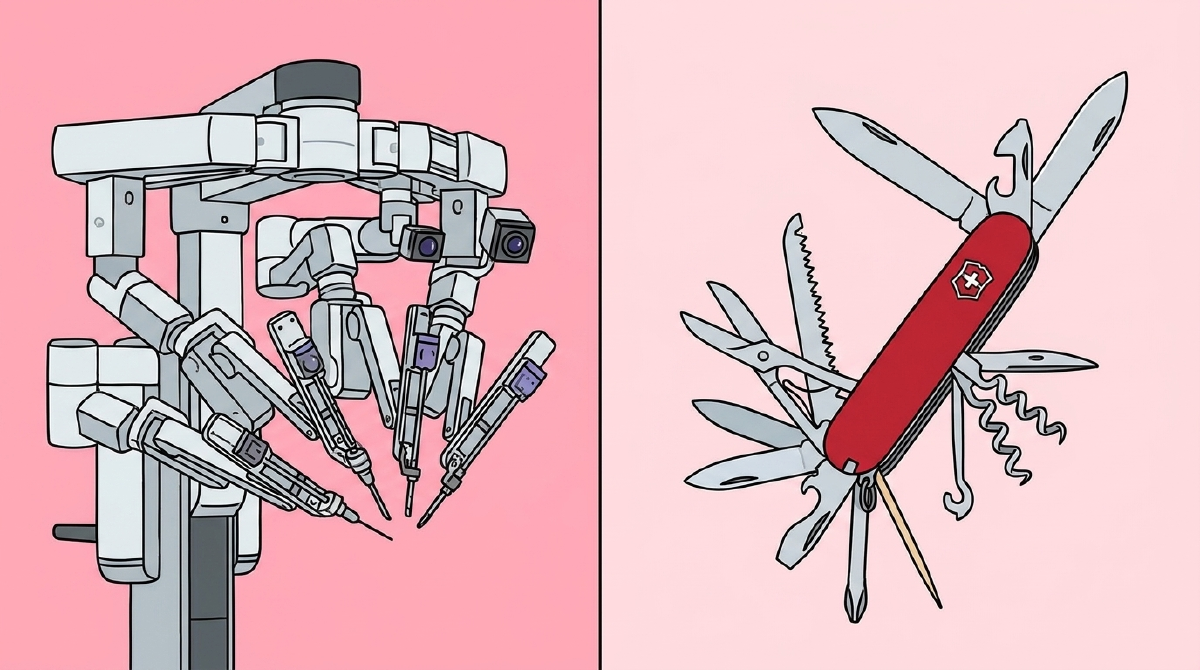

You just finalized your initial funding. The capital is sitting in the bank account, and the pressure is suddenly real. You need a team. The immediate impulse is to seek out people who have done precisely what you want to do. You look for a veteran salesperson from an established competitor. You search for a specialized engineer who only works on one specific framework. You assume deep expertise will solve your early problems.
But what happens when the problem itself changes next week?
That question often catches new founders off guard. They hire for the reality of today, forgetting that tomorrow might look entirely different. The early days of building a company are chaotic. You are not just building a product. You are searching for a functional business model.
This brings up a hiring philosophy that merits examination. In the beginning, you might want to look past the experts.
You might need generalists.
The Illusion of Deep Expertise
#When you hire a specialist, you are making a specific assumption. You are assuming your strategy is correct and will not change. A specialist is efficient in a predictable environment. If you know exactly how your customer acquires software, a specialized enterprise sales executive is a logical hire.
Startups rarely have that predictability.
Consider what happens when you pivot. Let us say your specialized engineer spent years mastering a specific database architecture. Three months later, customer feedback forces you to abandon that architecture entirely. Your specialist is now stranded. They are expensive, frustrated, and misaligned with your new trajectory.
This is a common failure point for early stage companies. They build an organization chart suited for a mature business. The reality of an early startup is much closer to an expedition into unknown territory. You do not need someone who only knows how to pave roads. You need someone who can clear brush, read a map, and fix a broken axle.
The Financial and Cultural Cost
#When you hire an expert too early, the financial drain is obvious. Specialists command high compensation packages. They expect resources, budgets, and teams to support their work. An early stage business rarely has these structures in place.
But the cultural cost is often more severe than the financial cost.
When a highly paid expert joins a small team and realizes the foundational elements are missing, friction occurs. They might demand that the company slow down to build enterprise grade processes. They might become defensive when their specific area of expertise is challenged by shifting customer demands.
This creates a slow down in execution.
The team begins to debate methodology instead of testing ideas in the real world. A generalist bypasses this friction. Because they are not deeply attached to one specific way of doing things, they are willing to build a messy, functional prototype just to see if the market wants it. This willingness to be unpolished is an operational advantage when capital and time are running out.
We must analyze this without assuming specialists are inherently problematic. They are valuable. The issue is purely a matter of timing.
The Biological Advantage of Adaptability
#Evolutionary biology offers an interesting parallel here. In stable environments, highly specialized species thrive. They adapt closely to a specific niche. But when a climate shifts rapidly, those specialized species are the first to face extinction. Generalist species survive because they can process different food sources and adapt to changing conditions.
A new business operates in a volatile climate.
Generalists possess a unique trait called high learning velocity. They are not defined by what they already know. They are defined by how quickly they can acquire new context. When a new challenge arises, a generalist does not say that it is outside their job description. They simply open a browser tab, read the documentation, and figure out a functional solution.
They are the utility players of the business world.
Consider a typical week for a generalist in a newly formed business:
- On Monday, they are analyzing user data to find drop off points in the software application.
- On Tuesday, they are drafting a sequence of emails to engage those exact users.
- On Thursday, they are helping the founder put together slides for an upcoming investor update.
- On Friday, they are researching legal compliance requirements for a new market expansion.

Generalists are comfortable with ambiguity.
No specialist would accept this workflow. A generalist thrives in it. They might write marketing copy on Monday, test software bugs on Tuesday, and call prospective clients on Wednesday. None of these tasks will be executed with the polished perfection of a twenty year veteran. But in the early stages, polished perfection is rarely the goal. The goal is survival and momentum.
Recognizing a True Generalist
#Identifying these individuals requires a different approach to interviewing. You cannot simply check boxes on a resume. You have to look for patterns of curiosity and adaptability.
Here are a few traits that often signal a capable generalist:
- They have non linear career paths. They might have started in customer support before moving to operations or product design.
- They ask structural questions. Instead of focusing only on their specific tasks, they want to understand how the entire business functions.
- They show a history of self directed learning. They often have hobbies or side projects that require them to master unrelated skills.
- They have low ego regarding task assignment. They are willing to do unglamorous work if it moves the project forward.
Generalists are comfortable with ambiguity.
They do not need a rigid playbook to begin working. They are capable of writing the initial draft of the playbook themselves.
The Shift in Organizational Needs
#It is important to view this objectively. Generalists are a strategic advantage early on, but they are not a permanent solution for every role.
As a company finds product market fit, the environment stabilizes.
The tasks become repeatable. The volume of work increases. At this juncture, the generalist approach begins to show fractures. If you are processing thousands of transactions a minute, a generalist engineer figuring things out on the fly becomes a liability. You need an expert in infrastructure scaling.
This creates an interesting organizational tension. The people who helped build the foundation are suddenly surrounded by specialists who are far more capable in specific domains. The rules of the game change, and the company has to adapt its management style.
Questions We Still Need to Answer
#This transition period remains one of the more difficult phases to navigate in business operations. There is no widely accepted metric that tells a founder exactly when to stop hiring generalists and start hiring specialists.
It forces us to ask several unresolved questions about organizational design.
How do you retain talented generalists when the company outgrows their broad, unstructured roles? Should generalists naturally transition into management positions because they understand the holistic view of the company? Or is there a natural expiration date on an early employee life cycle?
We need more data on how small businesses manage this structural shift. Researchers in organizational behavior are just starting to track the career trajectories of early startup employees. Until we have peer reviewed studies, founders must rely on observation and practical experience.
We do not have definitive answers to these questions. Every company handles this transition differently. Some organizations create specific rapid response teams for their early generalists. Other companies watch those early employees depart to join new startups where they can return to the chaotic, unstructured work they enjoy.
The critical takeaway is awareness.
If you are building something right now, look at your immediate needs. Look at your level of certainty. If your path is obscured by unknowns, prioritize the people who can adapt to the darkness. Deep expertise will be waiting for you when the lights finally turn on. Until then, hire for adaptability. Hire for curiosity. Hire the generalist.
Related Reading
#- The Specialist Shift: Replacing the Generalists Who Got You Here
- How to hire for range in early startup teams
- How to identify the right moment for your first non-founder hire
- How to determine the timing for your first non founder hire
- Imposter Syndrome in Growth Phases: Handling the Fear of Being Unqualified