

The Demo Skill: Solving Pain Instead of Dumping Features
#I sat in a conference room with a founder who had spent eighteen months building a logistics platform. He was brilliant. The code was clean and the infrastructure was scalable. He had secured a meeting with a potential pilot customer who desperately needed to fix their shipping delays.
The projector hummed to life.
Over the next forty minutes, I watched the founder click through every single tab on the dashboard. He explained the settings panel. He showed how to change the color themes of the user interface. He detailed the backend database structure and how the API handled rate limiting.
The potential customer nodded politely. They checked their watch twice.
When the meeting ended, the customer said they would think about it. They never called back.
The founder was confused. He had shown them a perfect product. He had demonstrated that it could do everything they could possibly want and more. Why did they walk away?
This is the paradox of the product demo. The more you show, the less the customer sees. It is a trap that catches almost every technical founder at least once. We mistake our pride in creation for the customer’s interest in utility.
The Curse of Knowledge
#When you build something from scratch, you know the effort required for every feature. A simple button might have taken three weeks of complex engineering to get right. When you present that button, you unconsciously want the viewer to appreciate the work behind it.
You want to show the settings page because you spent a month on the user permissions logic.
But the customer does not care about your effort. They care about their problem.
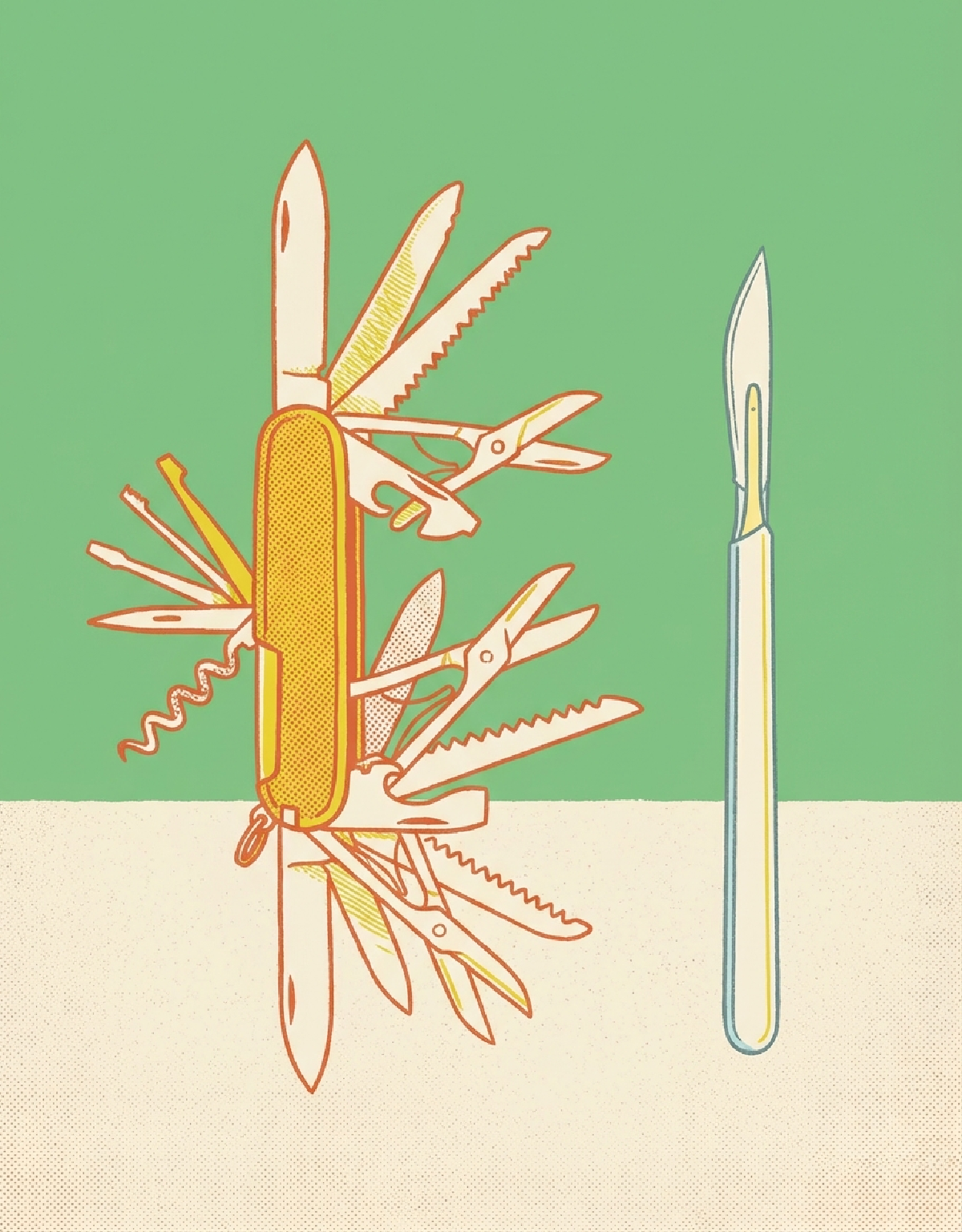
This leads to the Feature Dump. This is where a presenter operates under the assumption that the value of the product is the sum of its features. The logic follows that if I show you fifty features, the value is higher than if I show you five.
This is mathematically correct but psychologically wrong.
In a sales context, value is defined by relevance. If you show a prospect ten features and only one solves their immediate pain, the other nine are not neutral add-ons. They are noise. They dilute the impact of the one thing that actually matters.
Cognitive load is a real constraint. Your prospect is likely tired, stressed, and thinking about their own to-do list. When you force them to process information that is not relevant to their immediate survival or success, they disengage. The founder in my story lost the deal not because the product lacked capability, but because he buried the solution under a mountain of irrelevance.
Diagnosis Before Prescription
#A doctor never writes a prescription before asking where it hurts. Yet, founders often open their laptops and start demoing before they have asked a single question.
To master the demo skill, you have to stop viewing the demo as a presentation. It is not a performance. It is a verification of a diagnosis.
Before you ever share your screen or plug into a projector, you must understand the specific pain. This requires a discovery phase that feels more like an interview than a sales pitch. You need to uncover the root cause of their frustration.
Are they losing money? Are they wasting time? Is the team burning out?
Let’s say you are selling project management software. A feature dump looks like this:
“Here is the calendar view, and here is the Gantt chart, and here is how you export to CSV.”
A diagnosis-led approach looks like this:
“You mentioned earlier that your team misses deadlines because nobody knows who is assigned to which task. Is that the biggest bottleneck right now?”
Once they agree, you have a mandate. You are no longer selling software. You are solving the ‘missing deadline’ problem.
We have to ask ourselves a difficult question here. Do we actually know what problem we are solving? Or are we just hoping that if we throw enough features at the wall, the customer will figure it out for themselves?
The Sniper Approach
#Once you have the diagnosis, you must exercise restraint.
The most effective demos are often the shortest. If you have identified that the customer’s main pain point is invoicing errors, your demo should focus almost exclusively on the invoicing workflow.
This requires courage. It means you have to deliberately hide 90% of what you have built.
Walk them through the specific narrative of their workday changing. Start with the problem they just admitted to having. Show the specific screen or click that eliminates that problem. Then stop.
This is the Sniper Approach.
You are connecting the dots for them. You are saying, “Here is the pain you have. Here is the screen that kills that pain. Here is the result.”
If you do this correctly, the customer will often interrupt you. They will ask, “But can it also do X?”
This is a buying signal. It means they have accepted the core solution and are now looking to see if it fits the rest of their requirements. Now you can show them feature X. But you only show it because they asked for it, not because you wanted to show it off.
Consider the difference in how this lands for the customer. In the feature dump, they are overwhelmed. In the sniper approach, they feel understood. The product feels tailored to them, even if it is the exact same software you show everyone else.
The Check-In Loop
#There is a tactical element to this that is easy to learn but hard to practice. It involves silence.
During a demo, the natural tendency is to fill dead air. You click a button, the page loads, and you talk over the loading time. You move from one section to another without pausing because you are afraid of losing momentum.
Momentum is not speed. Momentum is agreement.
After you show a feature that solves a pain point, you need to stop. You need to take your hands off the keyboard and look at them. You need to ask a question that forces them to process what they just saw.
“How would this impact your current workflow?”
“Does this look like it would solve the issue you mentioned earlier?”
Then, you wait.
This silence is uncomfortable. It feels like something is wrong. But in that silence, the customer is doing the work. They are imagining using the tool. They are calculating the value.
If you keep talking, you rob them of that processing time. You interrupt the very moment where the sale actually happens in their mind.
Building The Skill
#This is not about being a slick salesperson. It is about scientific rigor in communication. It is about hypothesizing a problem, confirming it with the subject, and demonstrating the proof of the solution.
You are building a business in an environment where attention is the scarcest resource. You cannot afford to waste it on features that do not matter.
Next time you prepare for a call, look at your product. Identify the three features that actually drive value for this specific person. Commit to showing only those three. If you feel the urge to show the settings panel or the export function, write it down and save it for the second meeting.
The goal is not to prove you worked hard. The goal is to prove you can help.
When you shift from showing what you built to showing how they win, you stop being a presenter and start being a partner. That is the only way to build something that lasts.