

You are likely sitting in a position where you believe you have a handle on your business.
The dashboards show steady growth. Your direct reports assure you that the roadmap is on schedule. The weekly syncs are efficient and everyone nods at the right times during the all-hands meeting.
Yet there is often a nagging suspicion that settles in the stomach of every founder eventually.
It is the quiet worry that you are only seeing a curated version of reality.
You wonder if the optimistic reports from your VP of Engineering match the actual frustration of the developers writing the code. You wonder if the sales projections match the conversations the account executives are actually having with customers.
This is not about mistrust. It is about the physics of information transfer.
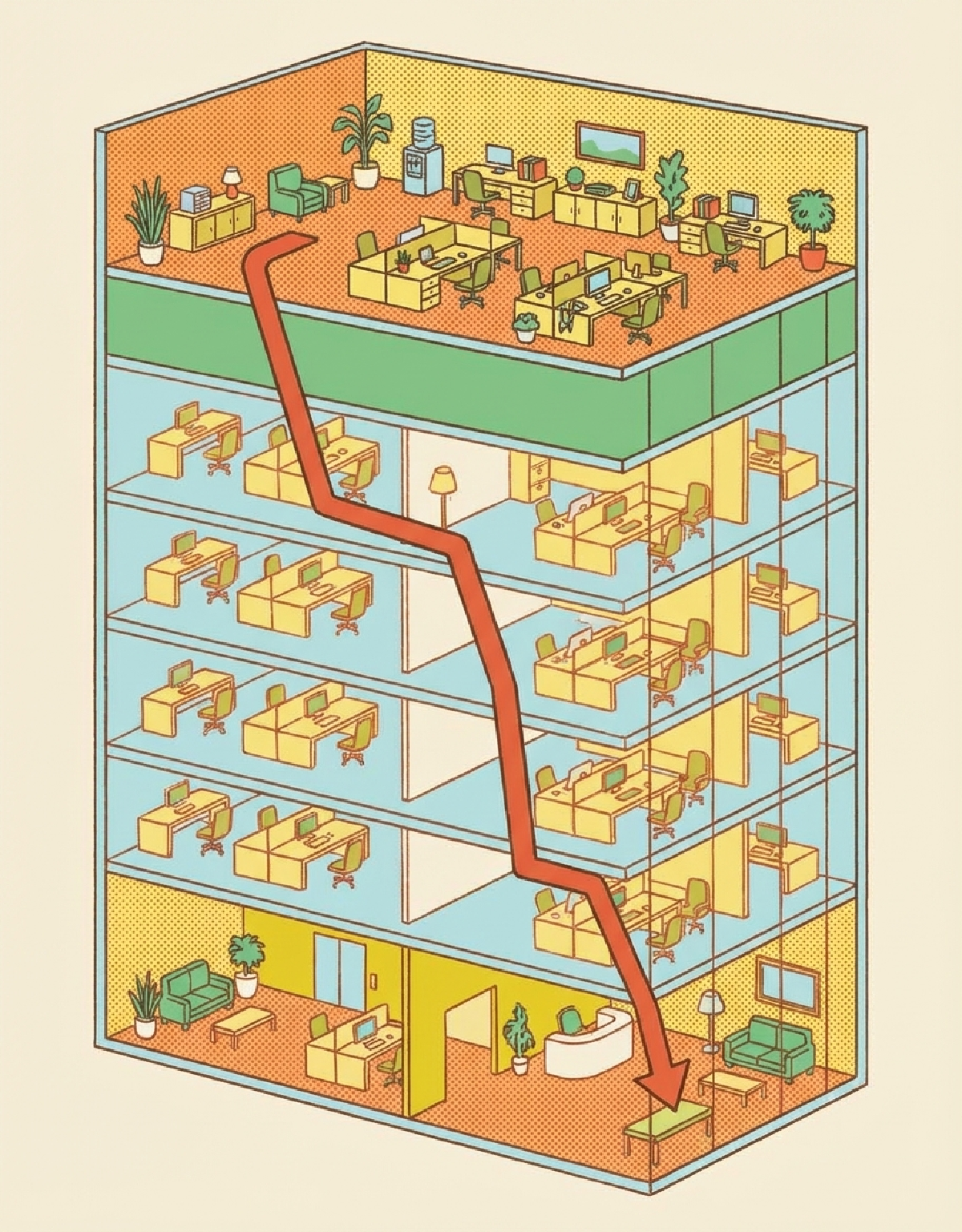
As an organization adds layers, the signal-to-noise ratio degrades. Nuance is lost. Ugly truths are polished until they look like minor hiccups. By the time information reaches your desk it has often been sanitized to the point of uselessness.
There is a mechanism to solve this. It is called the skip level meeting.
It is not a performance review. It is not a witch hunt. It is a debug tool for your organizational structure.
The Physics of Information Loss
#Every time a human being passes information to another human being, they apply a filter.
This filter is made of their own biases, their desire to look competent, and their fear of conflict. Your direct reports want to solve problems before they reach you. This is generally a good instinct. You hired them to handle things so you do not have to.
However, this filtering creates a blind spot.
When a manager shields you from the day-to-day friction, they also shield you from the early warning signs of systemic failure.
I once worked with a founder who only spoke to his three co-founders. They told him the product was market-ready. It was only when he sat down with a junior support rep that he learned the software crashed every time a user tried to export a CSV file. The founders knew about the bug but considered it low priority. The support rep knew it was causing 20 percent of their churn.
That single conversation changed the company roadmap.
The skip level meeting creates a tunnel through the hierarchy. It connects you directly to the source of the work.
But starting these meetings requires careful architecture. If you implement them poorly you will destroy the trust of your middle managers and terrify your junior staff.
Managing the Middle Layer
#The biggest risk in rolling out skip level meetings is not what you hear. It is how your direct reports feel about you hearing it.
Your VPs and Directors may view this as a violation of the chain of command. They might worry you are spying on them or that you do not trust their leadership.
If they feel undermined, they will become defensive. They might even coach their teams on what to say to you which defeats the entire purpose of the exercise.
You must frame this correctly before you send a single calendar invite.
Sit down with your direct reports first. Explain the scientific intent of the process. Tell them that your goal is to understand the broader sentiment of the company and to spot patterns that affect everyone.
Make it clear that these are not secret tribunals.
You can even ask your managers what they are worried about. Ask them if there are specific topics they think you should dig into. Turn them into collaborators in the process rather than subjects of investigation.
When the middle layer feels safe, the data you get from the lower levels will be more accurate.
The Architecture of the Meeting
#You should schedule these meetings for 30 minutes. Anything longer feels like an interrogation. Anything shorter feels dismissive.
Do not hold them in your office if you have one. Go to them. Or meet on neutral ground. If you are remote, keep it casual.
The tone must be inquisitive, not accusatory.
You are there to learn. You are there to listen.
Many founders make the mistake of using this time to preach. They want to instill vision. They want to motivate.
Resist that urge.
You have town halls for vision. You have emails for updates. This time is for extraction.
I have found that open-ended questions yield the highest quality data. Questions that can be answered with a simple yes or no are dead ends. You want to trigger a narrative.
Try asking: “If you were in my seat for a day, what is the one thing you would change immediately?”
This question forces them to prioritize. It reveals what they view as the biggest bottleneck.
Another strong prompt is: “What is the hardest part of your job that you feel should be easier?”
This highlights process failures and tool deficiencies.
You should also ask about alignment: “When you talk to your friends about what we are building here, how do you describe it?”
If their answer differs wildly from your pitch deck, you have a communication breakdown.
Pattern Recognition vs. Anecdote
#You will walk out of these meetings with a notebook full of complaints, ideas, and observations.
The danger is immediate reaction.
If a junior developer tells you that the code review process is too slow, your instinct will be to slack the CTO and demand a change.
Do not do this.
One data point is an anecdote. Three data points is a pattern.
If you react to every single complaint, you become a chaotic force in the organization. You become the “squeaky wheel” executive. Your team will learn that the easiest way to bypass their manager is to complain to you.
Instead, aggregate the data.
If you do ten skip levels and eight people mention that cross-department communication is broken, you have a systemic issue. That is a fact you can take to your leadership team.
You can then present the problem without exposing the source.
“I am seeing a pattern where our teams feel siloed,” is a much more productive opening to a strategy meeting than “John said he hates how Marketing talks to Engineering.”
Closing the Loop
#There is one final component that makes this system work.
You must show that the time was valuable.
If you listen to fifty employees and nothing ever changes, they will stop talking. They will assume you are just going through the motions to appear connected.
You do not need to solve every problem. But you do need to acknowledge them.
In your next all-hands or email update, reference the feedback.
“I have been doing skip levels and I heard from many of you that our internal tools are slowing you down. We are allocating budget next quarter to fix that.”
This closes the loop. It proves that the signal traveled from the edge of the organization to the core and that the core responded.
Business is complex. It is a web of human interactions, technical challenges, and market forces.
You cannot navigate it if your map is based on hearsay.
Go to the source. Ask the questions. Listen to the answers.
The truth is usually right there, waiting for someone to ask for it.