
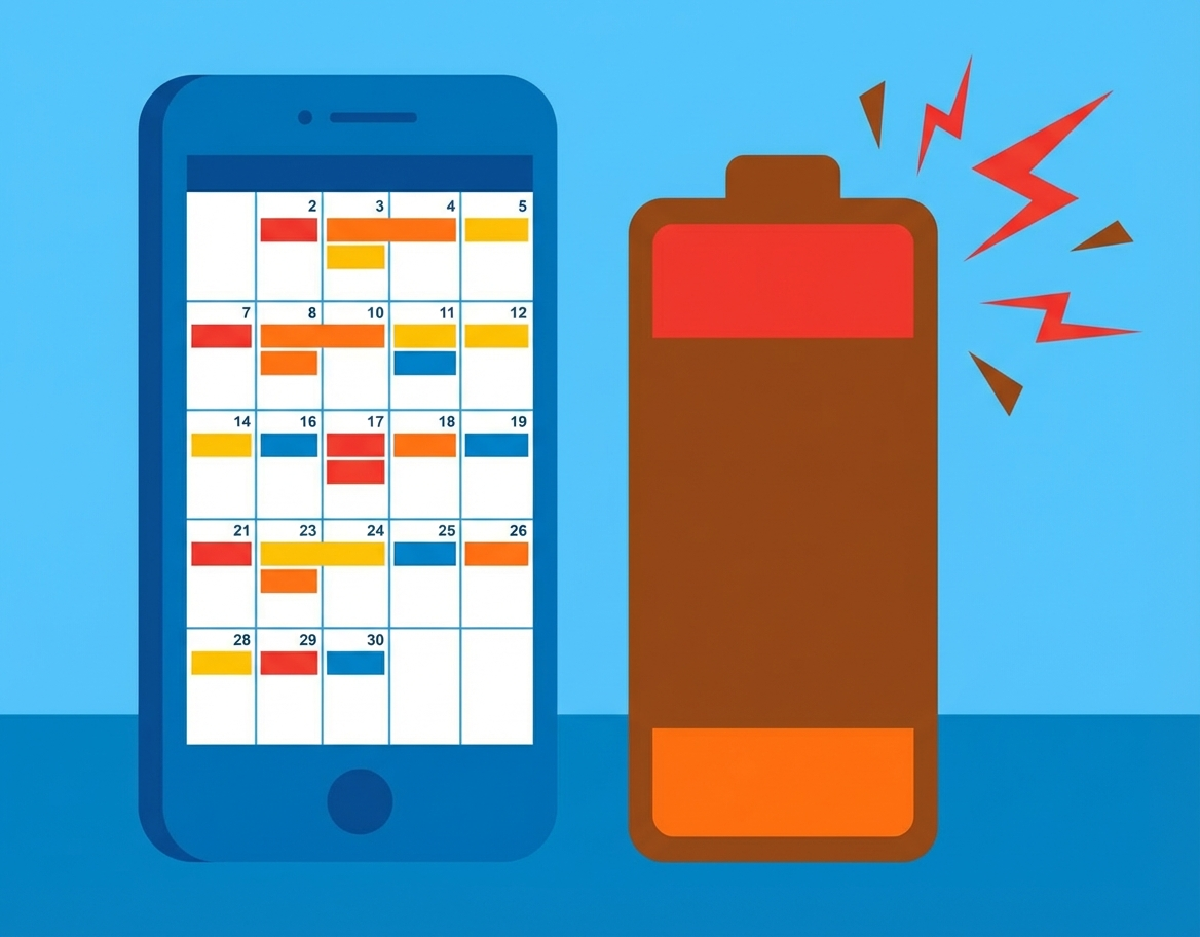

I remember staring at my phone on a Thursday afternoon. It was vibrating. A group chat was lighting up about a dinner happening that night. It was a birthday for a friend of a friend.
I liked these people. I wanted to be the guy who showed up. I wanted to be the fun founder who could balance a high-growth company with a vibrant social life.
So I went.
I spent three hours making small talk, shouting over loud music, and nodding along to conversations I could barely hear. I got home late. I woke up tired.
The next morning, I had a product roadmap meeting. It was the kind of meeting where every sentence dictates the next six months of engineering time. I sat there, staring at the whiteboard, and realized my brain was stuck in a fog.
I made a decision that morning because I had to. It turned out to be the wrong one. We lost six weeks of development time correcting it later.
That dinner cost me fifty dollars. But the social fatigue cost the business thousands.
This is a variable we rarely account for in our operating models. We track cash flow. We track server uptime. We rarely track the biological uptime required to process complex information.
The Economics of Attention
#There is a prevailing myth that energy is renewable on a daily basis. We assume that if we sleep, we reset.
While sleep is vital, cognitive resources are more like a bank account than a solar panel. You start the week with a deposit. Every decision withdraws from it.
Every social interaction withdraws from it.
Psychologists refer to this as decision fatigue or ego depletion. The concept suggests that self-control and decision-making draw from the same finite resource pool.
When you force yourself to be engaged at a social event when you would rather be resting, you are burning fuel. You are engaging in high-level emotional regulation.
You are smiling when you want to be neutral. You are listening when you want to be thinking.
This is work.
It might look like leisure to the outside observer, but biologically, your brain is firing rapidly to maintain social cohesion. If you spend that energy at a bar on Thursday, it is not there for the investor call on Friday.
We need to start asking a difficult question.
Is the social obligation worth the degradation of your executive function?
Identifying the Leak
#Not all social interactions are expensive. Some are restorative.
This is where the nuance lies. If we simply cut off all human contact, we run into a different problem. Loneliness. Isolation also degrades performance. It leads to echo chambers and a lack of perspective.
The goal is not to become a hermit. The goal is to identify the difference between restorative connection and obligatory draining.
Restorative connection usually happens with close friends or family. It requires no performance. You can be tired. You can be quiet. You can be yourself without the armor. These interactions can actually refill the tank.
Obligatory draining is different.
It usually involves:
- Strangers or loose acquaintances
- Loud environments necessitating high sensory processing
- The need to impress or maintain a specific persona
- Travel time or logistical friction
When you look at your calendar, you likely see time blocks. You do not see energy blocks.
A one hour coffee with a potential mentor might be net positive. A three hour cocktail party with neighbors might be a massive net negative. Yet on the calendar, the party just looks like a block of time.
We have to stop managing time and start managing cognitive load.
The Social Audit
#
I started doing something that felt cold at first. I audited my friends and family.
I did not cut people out of my life permanently. I just recategorized how and when I saw them during building phases.
If we are in a sprint, or closing a round, or launching a feature, my capacity for obligatory socializing drops to zero.
Here is how you can look at it.
Category A: The Chargers. These people give you energy. You leave dinner feeling ready to conquer the world. Keep these on the calendar. They are an asset.
Category B: The Neutrals. It is fine. It is not great, it is not bad. It is just time passed. Cut these during high-pressure weeks. They are a luxury you cannot afford right now.
Category C: The Drainers. These are the events you dread. The obligations you accepted out of guilt. The people who constantly ask to pick your brain without offering value.
For a founder, Category C is toxic. It is a liability.
When you say yes to a Category C event, you are actively choosing to be less effective at your job. You are choosing to be a worse leader for your team.
It sounds harsh. But business is a game of resource allocation.
Navigating the Pushback
#The hardest part of this is the social friction. People take no personally.
When you decline a wedding invite or skip the neighborhood barbecue, people assume you are arrogant. They assume you think you are better than them.
They do not understand the mental weight you are carrying.
They go to work, they come home, and they are done. You go to work, you come home, and you are still processing the cash burn rate while you brush your teeth.
You do not need to explain this to everyone. You do not need to justify your absence with a presentation on cognitive load.
You just need a standard operating procedure for declining.
Keep it short. Be polite. remove the open-ended possibility.
Instead of saying Maybe next time or I will try to make it, say this.
I am heads down on a major project right now and have to keep my schedule clear to get it over the line. I hope you guys have a great time.
It is honest. It is firm.
Most importantly, it protects the asset.
The Open Questions
#There is a risk here. I worry about it often.
If we optimize our lives entirely for business execution, do we lose the serendipity that makes life interesting?
Some of my best business ideas came from random conversations at parties I did not want to attend. Some of my best hires were friends of friends I met at weddings I tried to skip.
By tightening the filter, we exclude the noise. But sometimes the signal is hidden in the noise.
We also risk damaging relationships that have long-term value for the sake of short-term focus. Is it worth missing a friend’s milestone to ensure a slightly better product launch?
Maybe not.
These are the trade-offs we have to weigh.
But we should weigh them with eyes open. We should make these choices as calculated risks, not as default reactions to a vibrating phone.
I eventually apologized to my team for that bad decision I made after the Tuesday dinner. We fixed the code. We moved on.
But I learned my lesson.
My energy is the company’s energy. I have to guard it.