
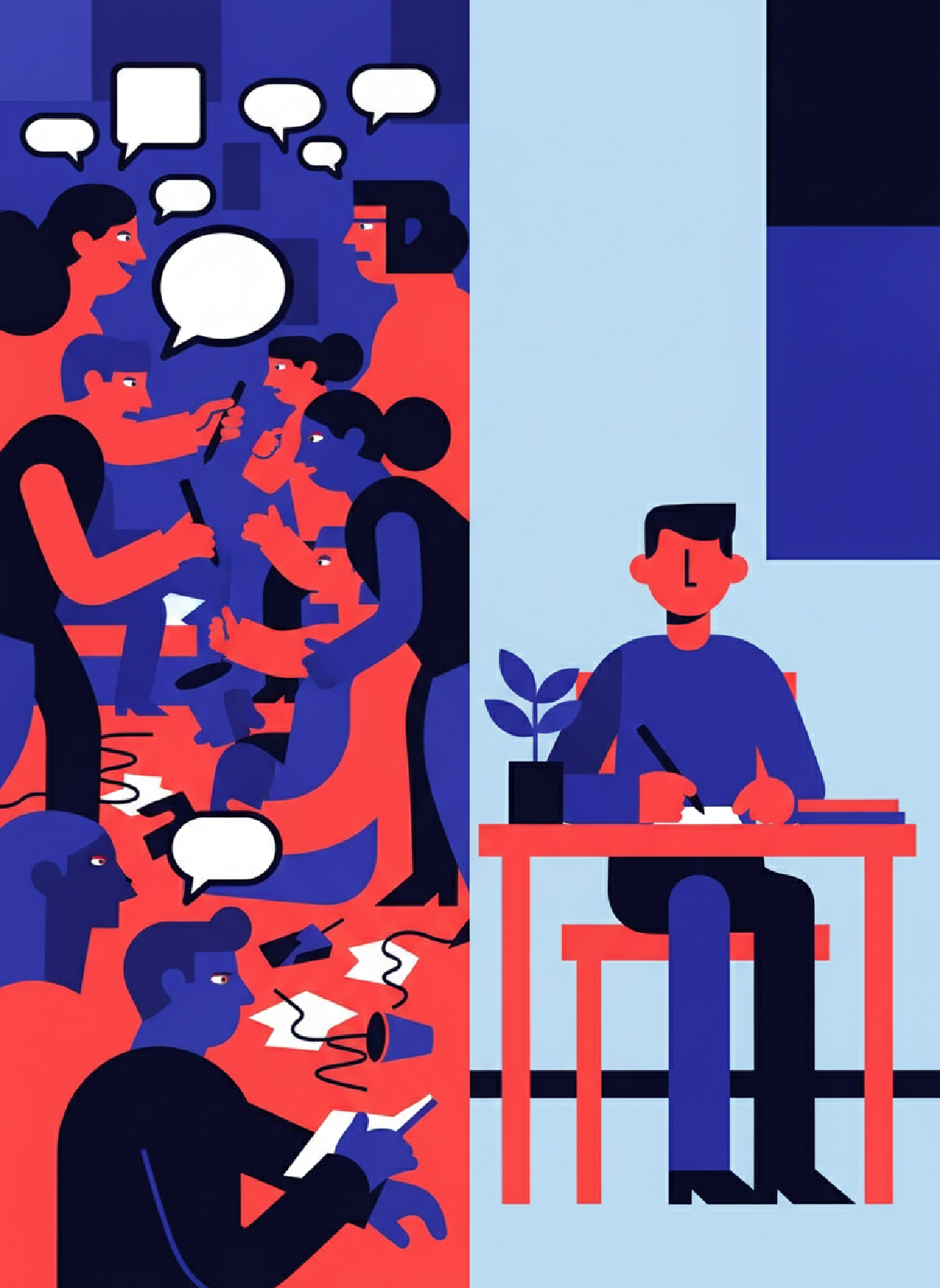

I remember a Tuesday in 2018 when I realized my entire team had stopped working despite being at their desks for ten hours. We were all in the office together. Everyone was busy. But as I looked at the commits to our codebase and the progress on our marketing collateral, the needle had barely moved. We were trapped in a cycle of immediate feedback. If someone had a query, they walked to a desk and asked it. If someone needed a decision, they gathered four people for a quick sync. We felt productive because we were active. But activity is a poor proxy for progress. This led me to wonder if the very tools we used to stay connected were the things keeping us from our best work. Is it possible that the faster we communicate, the slower we actually build?
The answer lies in the hidden cost of the interrupt. Every time a team member is pulled away from a complex task to answer a simple question, they pay a cognitive tax. Research suggests it can take upwards of twenty minutes to return to a state of deep focus after a single distraction. When you multiply that by five interruptions a day, you have effectively lost the ability to do meaningful work. This is the synchronous trap. It is the belief that every message requires an instant reply and every problem requires a live discussion. To build something that lasts, we have to find a way to break this cycle. We have to learn the art of working apart, even when we are together.
The Illusion of Speed in Real Time
#We often prioritize real time communication because it feels efficient. You ask a question and you get an answer in thirty seconds. On the surface, that seems like a win. However, this ignores the ripple effect on the person providing the answer. You saved thirty seconds, but you might have cost the company an hour of their peak mental output. In a startup environment where resources are thin, this is an expensive way to operate. Real time communication is often a tool for the lazy. It allows us to offload our need for information onto someone else without doing the legwork of thinking through the problem first.
When we force ourselves to communicate asynchronously, the quality of our thought improves. If I know that I cannot get an answer for four hours, I am forced to structure my question clearly. I have to provide context. I have to explain what I have already tried. This process of writing things down often leads to the asker solving their own problem before they even hit send. It creates a record of decision making that others can reference later. It turns a fleeting conversation into a permanent asset for the company.
The Science of the Focus Tax
#Cognitive load theory suggests that our working memory has limited capacity. When we are deep in a task, we are holding multiple variables in our mind at once. An interruption flushes that cache. The recovery period is not just about returning to the desk; it is about rebuilding that mental model. By moving to a written culture, we allow individuals to control when they consume new information. They can batch their communications into specific windows, leaving large blocks of time for the deep work that actually creates value.
This shift requires a fundamental change in how we view availability. In many organizations, being available is seen as being a good teammate. In an asynchronous organization, being unavailable is seen as a sign of respect for the work. It signifies that you are doing the very thing the company hired you to do. We must ask ourselves: do we want a team that is always responsive, or a team that is always effective? It is rarely possible to have both.
Implementing the Written Standard
#
Writing for internal consumption should be clear and devoid of jargon. It should follow a consistent structure: what is the goal, what is the data, and what is the recommendation? When a team learns to write, they learn to think. You cannot hide a lack of logic in a well written paragraph the same way you can hide it in a fast paced conversation. This creates a high bar for ideas before they ever reach the implementation phase.
Video as a Bridge for Context
#Sometimes text lacks the nuance of tone and emotion. This is where recorded video updates become a powerful tool. Instead of a daily standup meeting that drains thirty minutes from ten people, individuals can record a two minute clip of their progress. These clips can be watched at double speed whenever it fits into a teammate’s schedule. It preserves the human element of seeing a face and hearing a voice without demanding a specific slot on a calendar.
Video is particularly useful for walkthroughs of design or code. It allows the creator to explain the why behind their choices. It provides a visual layer that text sometimes struggles to capture. The key is to keep these videos short and focused. They are not meant to be polished productions; they are meant to be efficient transfers of information. If a video is longer than five minutes, it probably should have been a document.
The Unsolved Problems of Async
#While the productivity gains are documented, asynchronous work is not a perfect system. There are still many unknowns that we are navigating as a business community. How do we maintain social cohesion and trust when we rarely speak in real time? There is a certain magic to the spontaneous spark of a live conversation that is difficult to replicate in a comment thread. We have to wonder if the lack of friction in async work also leads to a lack of creative heat.
There is also the risk of isolation. If a founder only communicates via text and video, they may lose the pulse of the team’s morale. We do not yet have a scientific consensus on how long a team can go without real time interaction before the cultural bonds start to fray. This is why many successful async companies still hold occasional retreats or high intensity strategy sessions. They use their synchronous time sparingly and intentionally, treating it as a precious resource rather than a default setting.
Building a Durable Culture
#To adopt these habits, you must first address the fear that your team is missing something. This fear drives the need for constant pings and status checks. As a leader, you must model the behavior. Stop rewarding the fastest replier. Start rewarding the most thoughtful document. When you stop responding to every message within seconds, you give your team permission to do the same. You create a sanctuary for their focus.
This is not about working less; it is about working better. It is about acknowledging that the human brain is not a multi threaded processor. It is a tool designed for deep, singular focus. By protecting that focus through asynchronous communication, you are building a business that is not just productive, but sustainable. You are creating an environment where people can do the best work of their lives without burning out from the constant noise of the modern office. The goal is to build something remarkable, and that requires the quiet space to think.