
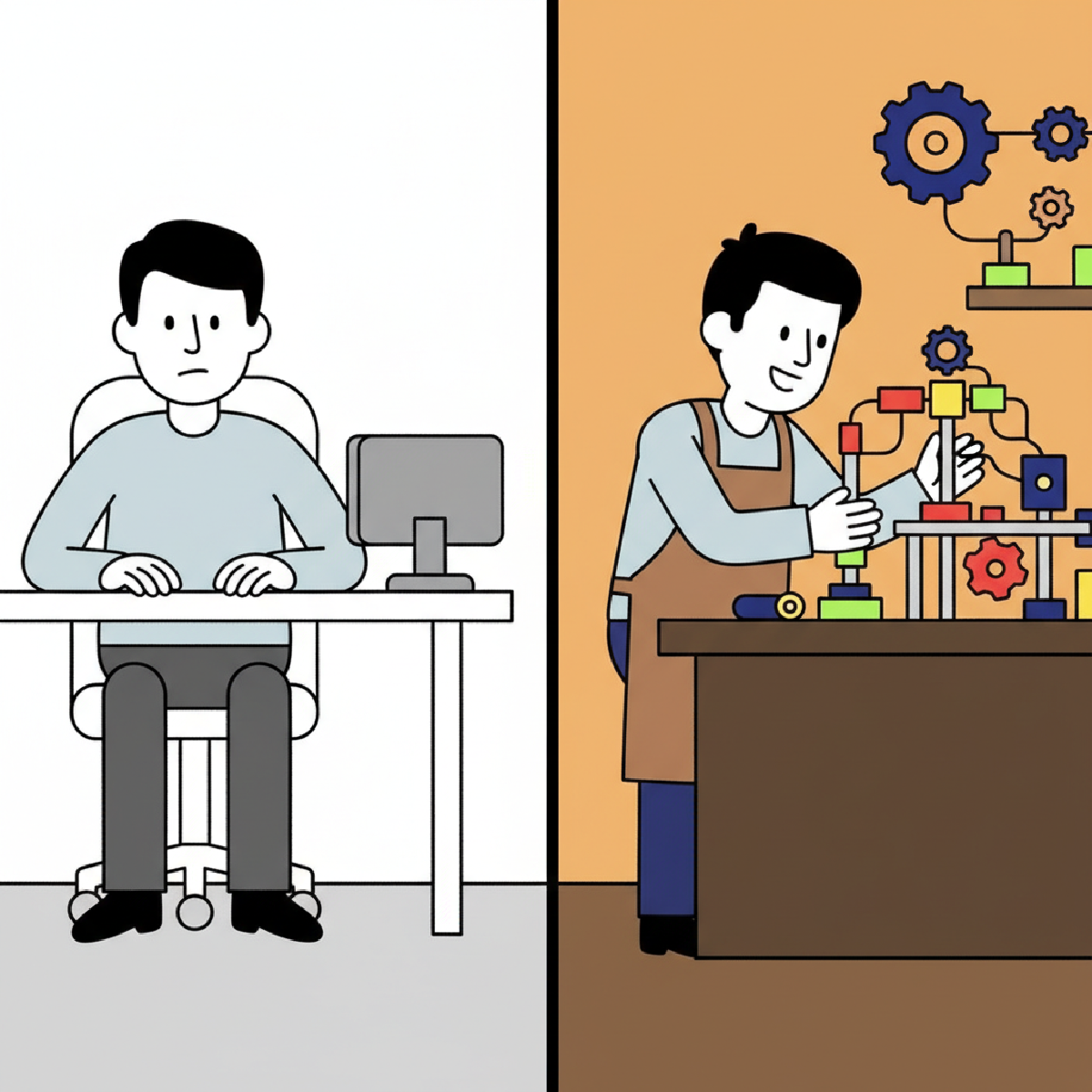

A few years ago, a friend of mine named Elias sat in a small coffee shop in downtown Chicago. He held a job offer in his left hand and a rough draft of a partnership agreement in his right hand. The job offer was for a senior role at a stable, well funded financial institution. It came with a clear career path, a significant signing bonus, and the kind of health insurance that makes you feel invincible. The partnership agreement was for a bootstrapped logistics startup that had three months of runway and a very messy office.
Elias was paralyzed. He was 30 years old and had a young family. The safe choice was obvious to everyone around him. His parents encouraged the bank job. His peers pointed out the volatility of the current market. Every logical signal in his immediate environment screamed at him to take the paycheck and play it safe. But Elias felt a nagging tension that he could not quite name. He was terrified of the risk of the startup, but he was more terrified of something else that he could not yet define.
What happens when we make decisions based solely on the data we have today? We often optimize for the preservation of our current state. This is a biological imperative. Our brains are wired to avoid immediate threats and seek immediate rewards. However, building something remarkable requires a different kind of calculus. It requires us to look past the immediate horizon and consider a data point that is often ignored: the perspective of our future selves.
The High Cost of the Safe Choice
#In the world of entrepreneurship, we are often told to mitigate risk. We study market trends, we build financial models, and we conduct customer discovery. These are all essential practices. But there is a specific type of risk that no spreadsheet can capture. It is the risk of reaching the end of your career and realizing that you spent your best years building things that did not matter to you.
When we choose the safe path today, we are often just deferring discomfort. We trade the acute stress of uncertainty for the chronic ache of unfulfilled potential. This is a trade that many people make because the acute stress is visible and immediate, while the chronic ache is invisible and distant.
- Immediate safety provides a sense of control.
- Long-term regret is often the result of prioritizing that control over growth.
- The most stable path is frequently the one that leads to the least amount of personal and professional impact.
We must ask ourselves a difficult question. Is the safety we are seeking today actually protecting us, or is it just preventing us from doing the work we were meant to do?
The Logic of Your Future Self
#Jeff Bezos famously popularized the Regret Minimization Framework when he was deciding whether to start Amazon. He projected himself forward to age 80. He knew that at 80, he would not regret trying to participate in this thing called the internet, even if he failed. He also knew that he would definitely regret not trying.
This is not just a clever mental trick. It is a fundamental shift in how we process information. When we look at a decision from the perspective of our 80 year old selves, the noise of the present day falls away. The fear of a failed startup, the embarrassment of a public mistake, and the temporary loss of income all seem much smaller.
What remains is the weight of the opportunity. The perspective of the future self allows us to see the difference between a temporary setback and a permanent missed opportunity. It forces us to acknowledge that the greatest risk is not failure, but the omission of effort.
Quantifying the Intangible
#How do we actually apply this logic when the stakes feel high? It starts with identifying the specific things we are afraid of. Are we afraid of losing money? Are we afraid of looking foolish? Are we afraid of the hard work required to pivot if things go wrong?
Scientific research into decision theory suggests that humans are naturally loss averse. We feel the pain of a loss twice as much as we feel the joy of a gain. This bias skews our decision making toward the status quo. To counter this, we have to create a mental environment where the cost of inaction is just as visible as the cost of action.
Consider these questions for your own business:
- If I stay on my current path for ten years, what will my business look like?
- If I take the risk and fail, what is the actual worst case scenario for my life?
- In twenty years, which version of this story will I be prouder to tell my children?
When you frame the decision this way, you are not just choosing between a job and a startup. You are choosing which person you want to become. You are deciding which set of memories you want to carry with you.
The Role of Intellectual Curiosity
#One of the most interesting aspects of the regret minimization mindset is that it encourages a diverse range of learning. When you are no longer focused on just staying safe, you become free to explore different fields and topics. You realize that to build something truly solid, you need to understand more than just your niche.
You might need to learn about psychology to lead your team. You might need to learn about history to understand market cycles. You might need to learn about philosophy to stay grounded during the hard times. This pursuit of knowledge is a form of risk management. The more you know about the world, the better equipped you are to navigate the complexities of building a lasting organization.
We do not always know which piece of information will be the key to our next breakthrough. This uncertainty is not a flaw in the system; it is a feature of a creative life. The goal is to stay curious enough to keep asking the questions that others are too afraid to ask.
Building Something That Lasts
#Ultimately, regret minimization is about building for longevity. It is about moving away from the get rich quick schemes that clutter the internet and moving toward work that has real value. A business built on a foundation of long term thinking is more likely to be remarkable because it is not constantly reacting to the whims of the moment.
It is built with the patience required to solve hard problems. It is built with the integrity required to earn trust. It is built with the understanding that the real reward is the process of creation itself.
Elias eventually put down the bank offer. He signed the partnership agreement for the logistics startup. It was not an easy road. There were months where they barely made payroll. There were moments when he questioned his sanity. But five years later, when he looks back, the fear he felt in that coffee shop seems like a distant memory.
He realized that the safety he was so afraid of losing was mostly an illusion. The real security came from the skills he developed, the team he built, and the fact that he no longer had to wonder “what if.”
What are you holding in your hands today? Is it a safe bet that you might regret in twenty years, or is it a challenge that scares you but promises a story worth telling? The choice is yours, but remember that your future self is watching. They are hoping you have the courage to choose the path that minimizes their regret.
The work is hard, and the outcomes are never guaranteed. But the clarity that comes from choosing the long view is worth every ounce of effort you put into it. Keep building.