


I sat across the table from a talented marketing lead a few years ago. She was asking for approval on a fifteen thousand dollar expense for a trade show booth.
I asked her a simple question.
What is the return we expect from this?
She looked at me with genuine confusion. She pulled up a spreadsheet on her laptop and pointed to a cell. She said that the money was already allocated in the Q3 marketing budget. In her mind the existence of the line item was the justification for the spend.
This is the allowance mentality.
It is one of the most dangerous dynamics in a growing company. It happens when managers view a budget as a pile of money they must protect or exhaust rather than a tool for generating value. They treat company capital like a child treats a weekly allowance. They spend it because they have it.
If you want to build a company that lasts you have to break this cycle.
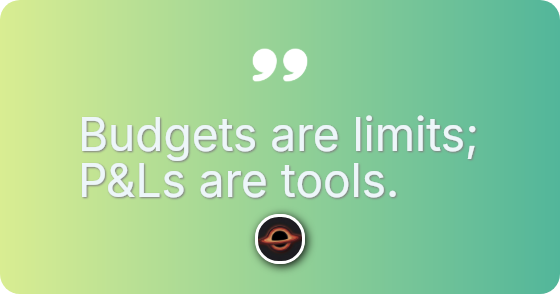
You have to teach your managers to stop managing budgets and start owning a P&L.
The Information Gap
#Most managers in small businesses or startups have never seen a Profit and Loss statement. They have likely never managed one either.
They operate in a vacuum where they only see the expense side of the equation. They see salaries and software costs and ad spend. They rarely see how those numbers interact with revenue or gross margin.
We cannot expect them to make ownership decisions if we hide the owner’s manual from them.
The first step in shifting this dynamic is transparency. You need to carve out a micro-P&L for their specific department. This does not mean you have to share the entire company bank balance or executive salaries if you are uncomfortable doing so.
It means you create a view where their department is the business.
Show them their top-line contribution. If they are in sales this is easy. If they are in engineering it might be the percentage of revenue attributed to the product lines they support. If they are in operations it might be an efficiency metric derived from gross revenue.
Then stack their costs against it.
When a manager sees that their department cost one hundred thousand dollars last month but only contributed eighty thousand in value the conversation changes. It is no longer about whether they have permission to spend money. It is about how they plan to fix the deficit.
This introduces a scientific approach to management. The numbers are the data points. The management decisions are the hypotheses.
The Investor Mindset
#The goal is to move the manager from a consumer of cash to an investor of capital.
Consumers ask if they can afford something. Investors ask what the return will be.
When I coach founders on this transition I tell them to ban the phrase “is it in the budget” from their meetings. Replace it with “what is the ROI.”
Let us go back to the trade show example.
Under the new framework the marketing lead would not point to a spreadsheet. She would have to argue that fifteen thousand dollars invested in the booth will generate fifty leads. She would estimate that those leads convert at ten percent with a lifetime value of five thousand dollars each.
The math changes.
Fifteen thousand dollars out. Twenty-five thousand dollars in.
Now she is not asking for permission to spend. She is presenting a business case for profit. If the math holds up she should not just spend the fifteen thousand. She should arguably spend more.
This empowers the manager. It removes the bottleneck of the founder having to approve every line item. If the manager understands the unit economics and the guardrails of the P&L they can make decisions without you.
Many managers are terrified of this responsibility. It is safer to simply follow a budget someone else created. If the plan fails they can blame the budget. If they own the P&L they own the failure.
Navigating the Unknowns
#There are variables here that we still have to figure out as we build.
One of the difficult questions is how to handle support functions. How do you create a P&L for HR or IT? These are typically cost centers. They do not generate direct revenue.
You have to get creative with how you attribute value.
Perhaps IT “charges” other departments for service. Perhaps HR is measured by the reduction in recruiting fees versus external agencies. We have to create proxies for revenue to simulate the market dynamics within the company.
Another open loop is the timeline of return.
If a manager invests in a long-term project that kills their P&L for two quarters but wins in the long run how do we incentivize that? We do not want to encourage short-termism where managers cut critical R&D just to make the monthly numbers look good.
This requires a cultural adjustment.
The P&L is a map but it is not the territory. You must teach managers that it is okay to run a deficit if the hypothesis is sound and the timeline is agreed upon.
The Review Cadence
#You cannot hand over a P&L and walk away. That is abdication not delegation.
You need a monthly financial review. This is not a scolding session. It is a strategy session.
Sit down with the manager and look at the variance. Where did we spend more than we thought? Why? Did that extra spend result in extra speed or quality?
Look at the savings. Did we spend less? Did that save money or did it starve the team of resources they needed?
This is where the nuance of business happens.
I often see managers who are so eager to prove they are good stewards that they stop spending altogether. They hoard their budget to show a profit. This creates a different kind of debt. It creates technical debt or burnout or missed market opportunities.
We have to teach them that the goal is not to not spend money. The goal is to spend money effectively.
Developing the Instinct
#This process takes time.
You are essentially trying to download your founder intuition into their brains. You are asking them to weigh risk and reward with the same gravity that you do.
They will get it wrong sometimes. They will make a bad investment. They will hire the wrong contractor or buy the wrong software.
That is the cost of education.
If you swoop in and fix it every time you rob them of the lesson. You have to let the small fires burn so they learn how to prevent the big ones.
The result is worth the pain.
Imagine a company where every department head thinks like a CFO. Imagine an organization where you do not have to police expenses because everyone is protecting the bottom line.
That is a resilient company.
It stops being a machine that eats cash and starts being a network of engines that generate value. It allows you to step back from the day-to-day financial policing and focus on the vision.
It turns your employees into partners. And that is how you build something that outlasts you.