

Let us look at a familiar scenario in the startup world. A founding team works tirelessly to build a minimum viable product. They manage to secure a seed round of funding. The immediate instinct is to step on the gas pedal. They hire a vice president of sales, bring on a growth marketing agency, and start pouring thousands of dollars into advertising channels. Traffic spikes. Demos are booked. It feels like success is imminent.
Yet, twelve months later, the bank account is nearly empty. Customer churn is incredibly high. The sales team complains that the leads are unqualified, while the marketing team argues that sales simply cannot close. What exactly went wrong here?
We will explore the mechanics of this failure shortly. The root cause usually traces back to a single critical error in the sequence of operations. They attempted to scale their distribution before they had proven their core value proposition.
The Mechanics of Premature Scaling
#In the early days of building a business, it is incredibly easy to confuse initial traction with actual product-market fit. You might have early adopters who are willing to overlook bugs because they are desperate for a solution. You might have friends and industry connections buying your software out of goodwill.
This early revenue is a positive signal, but it is not empirical proof that your product is ready for the masses.
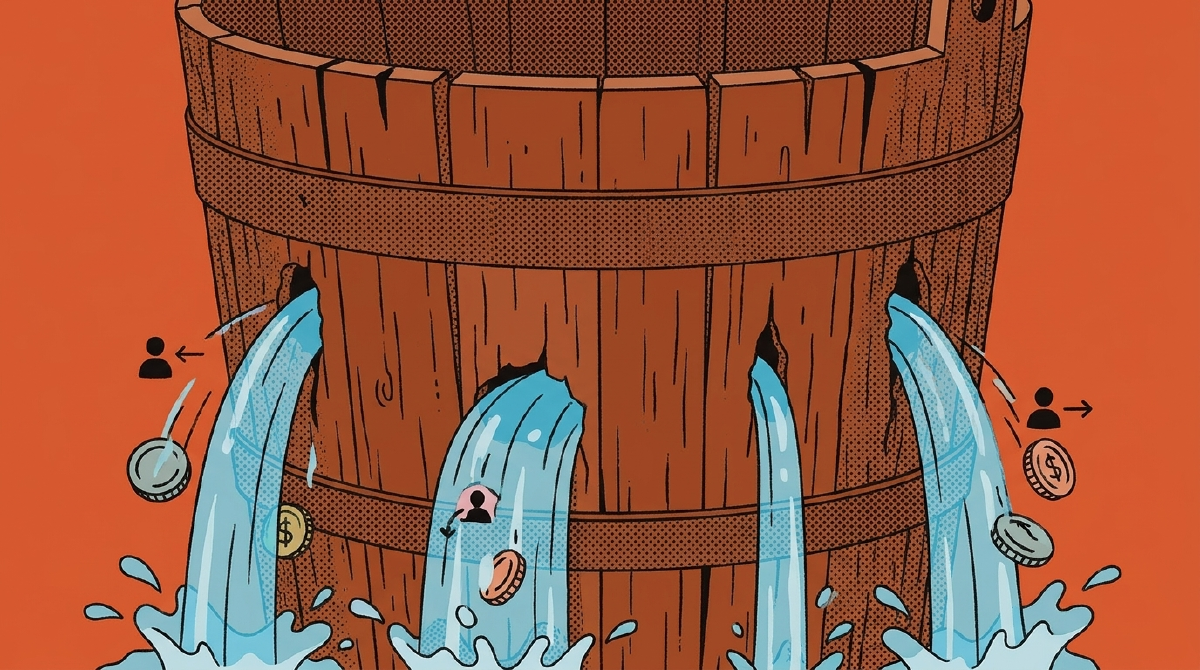
Scaling a sales and marketing operation before achieving true product-market fit is a lot like pouring water into a leaky bucket. You can keep the bucket full if you pour water in fast enough, but the moment you stop pouring, the bucket empties. In business terms, the water is your capital and the leaks are your product flaws.
When you hire a sales team to push a flawed product, you introduce a dangerous dynamic into your company. Sales professionals are highly skilled at overcoming objections. They use their charisma, relationships, and negotiation tactics to close deals. This sounds like a positive thing, but in the early stages, it is actually destructive.
If a salesperson talks a hesitant customer into buying a product that does not actually solve their problem, that customer will inevitably churn. Worse, the founder looks at the revenue numbers and assumes the product is working. The sales team effectively masks the product flaws, feeding the company false data.
Diagnosing True Product-Market Fit
#How do we know when a company has actually crossed the threshold into product-market fit? Is it a specific revenue number? Is it a certain number of daily active users?
These are questions that plague almost every founder. The truth is that product-market fit is not a single milestone. It is a spectrum. However, we can use a scientific approach to measure where we sit on that spectrum. Instead of relying on gut feelings, we must look at the empirical data.
Think of your startup as a laboratory. Every feature you ship is an experiment. Every customer interaction is a data point. If you introduce variables too quickly, such as massive ad spend or a dozen new sales reps, you ruin the experiment. You can no longer isolate what is actually working.
There are several specific indicators you can measure to diagnose your current state:
- Customer Retention Rates: Are users sticking around month after month? If your churn rate is high, your product is not fully solving the problem.
- Organic Acquisition: Are new customers finding you through word of mouth? A strong product generates its own gravity.
- Engagement Metrics: Are users logging in daily or weekly? Are they utilizing the core features of your platform?
- The Sean Ellis Test: If you survey your users and ask how they would feel if they could no longer use your product, what percentage would be very disappointed? The standard benchmark suggests that if forty percent or more say they would be very disappointed, you have strong fit.
If these metrics are weak, pouring money into marketing will only accelerate your failure. You will simply pay a premium to acquire customers who will leave shortly after arriving.
The Hidden Costs of Premature Growth
#Beyond the obvious financial drain, scaling too early inflicts hidden costs on your organization.
First, it destroys team morale. When marketing is generating leads that sales cannot close, friction develops between departments. Finger-pointing becomes the default culture. The marketing team blames sales for poor execution. The sales team blames marketing for poor targeting. Meanwhile, the engineering team is overwhelmed with feature requests from angry customers who were promised things that do not exist.

It is vital to ask ourselves what we do not yet know about our target audience. Are we making assumptions about their daily workflows? Are we projecting our own preferences onto their buying habits?
Operating in the Pre-Fit Phase
#If you should not scale sales and marketing yet, what exactly should you be doing? The answer lies in founder-led sales and unscalable growth tactics.
As a founder, you must be the primary salesperson until the product-market fit equation is solved. You possess the deep industry knowledge and the vision required to understand the nuances of a customer rejection. When a prospect tells a hired sales representative no, the representative simply moves on to the next lead. When a prospect tells a founder no, the founder can dig deep into the reasons why and adjust the product roadmap accordingly.
During this phase, your operations should look entirely different from a mature company. Consider the following approaches:
- Conduct long, qualitative interviews with every single churned customer to understand exactly where the product fell short.
- Manually onboard your new users to ensure they reach their desired outcome as quickly as possible.
- Offer highly personalized support to gather direct feedback on usability issues.
- Keep your burn rate as low as possible to extend your runway and give yourself time to iterate.
This phase of business is uncomfortable. It feels slow. When you look at your competitors announcing massive funding rounds and aggressive hiring plans, you will naturally feel a sense of panic. You will worry that you are missing out on key opportunities. It takes profound discipline to hold back. You will attend networking events where peers boast about their headcount and ad budgets. The urge to compete on those vanity metrics is strong.
Closing the Gap
#Let us return to the founding team from our initial scenario. Why did they fail despite having capital and a dedicated growth team?
They failed because they built an infrastructure to scale a hypothesis, rather than waiting to scale a proven reality. They allowed the pressure of growth to override the scientific process of customer discovery.
Building a remarkable, lasting business requires patience and discipline. It requires you to sit in the discomfort of not knowing all the answers. You must formulate hypotheses, test them with a small group of users, measure the results, and iterate.
Only when the data proves that your product is indispensable to your target market should you begin to build out your sales and marketing teams. When you finally reach that point, scaling will no longer feel like pushing a boulder up a hill. Instead, it will feel like trying to keep up with a runaway train.
Wait for the data.
Protect your capital.
Fix the leaks in your bucket before you turn on the hose.