
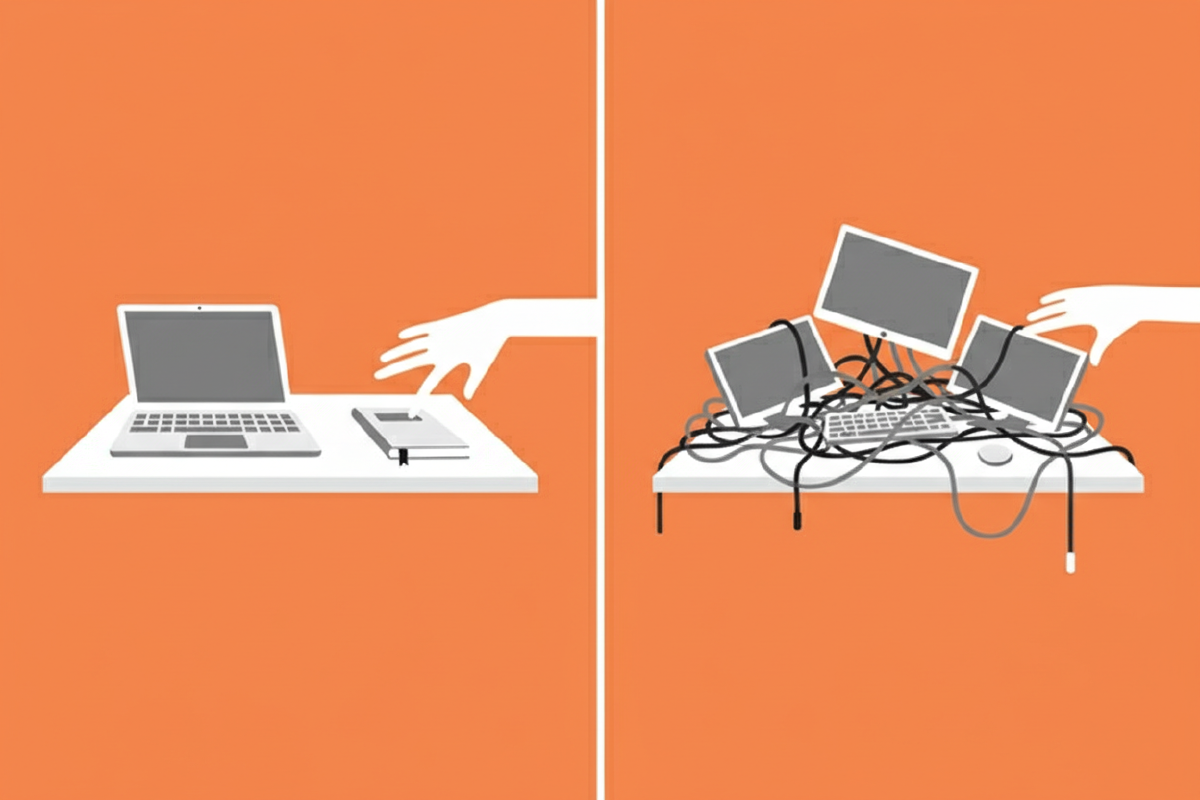

The Optimization Trap
#I vividly remember the week I decided to overhaul our project management system. I spent three days researching. I watched YouTube reviews. I compared feature matrices between Asana, Monday, ClickUp, and Linear. I felt productive. I felt like I was solving a massive bottleneck for the team.
By Friday, I had migrated all our data into the new shiny tool. I set up automations. I color-coded the tags.
Two weeks later, nobody was using it.
We went back to a shared spreadsheet.
This is a story I hear constantly from other founders. We confuse configuring software with doing work. In the early stages of building a company, we are terrified of chaos. We feel the ground shifting under our feet. To combat this anxiety, we try to control the environment.
We buy tools. We subscribe to SaaS products that promise to organize our thoughts, streamline our sales, and automate our marketing.
But here is the question we rarely ask until it is too late: at what point does the tool become the job?
If you are spending more time managing your software than serving your customers, you have fallen into the optimization trap.
The Hidden Cost of Context Switching
#There is a scientific concept known as switching costs. It refers to the cognitive effort required to shift attention from one task to another. In the context of business operations, this applies to shifting between different software interfaces.
Every time you move from Slack to Trello to HubSpot to Gmail, your brain has to re-render the context.
You lose focus.
Modern startups often brag about their stacks. They list twenty different niche tools that are “best in class” for specific problems. The design team uses Figma. The devs use Jira. Sales uses Salesforce. Marketing uses Marketo. HR uses Gusto. Docs are in Notion.
The result is a fragmented reality.
Data silos emerge naturally in this environment. When information lives in ten different places, there is no single source of truth. You spend your day asking where the latest version of the pitch deck is rather than pitching it.
This fragmentation creates operational friction. It slows down decision making.
We have to wonder if the 10 percent feature gain we get from a specialized tool is worth the 50 percent loss in operational velocity caused by the disconnect.
The Case for Boring Software
#Tech stack minimalism is the practice of choosing the fewest number of tools necessary to operate. It prioritizes integration over features.
It usually looks like this:
- One suite for communication and documents (Google Workspace or Microsoft 365)
- One tool for project tracking
- One tool for money
That is it.
When you are starting, you do not need a CRM. You need a spreadsheet. You do not need a complex HR platform. You need a payroll provider and a folder for contracts.
The goal is to maximize the overlap. If you are already paying for Google Workspace, use Google Meet. Is Zoom better? Maybe slightly. Is it worth managing another license, another login, and another app on your desktop? Probably not.
When you hire a new employee, you do not want to spend their first week training them on your obscure, customized project management workflow. You want them to start working. If your stack is standard, their ramp-up time decreases significantly.
Integration Beats Innovation
#We often look for the “best” tool for a specific job. But in operations, the “best” tool is the one that talks to your other tools without breaking.
An “all-in-one” platform that does five things adequately is often superior to five separate tools that do those things perfectly.
Consider the friction of data transfer. If your email marketing tool does not talk to your customer database natively, you have to build a bridge. You use Zapier or Make. You write scripts. You maintain APIs.
Suddenly, you are not running a business. You are maintaining a fragile web of integrations.
When one API changes, the whole system breaks. You spend your Saturday fixing a sync error instead of talking to users.
By accepting tools that are “good enough” but highly integrated, you remove technical debt before it even begins. You trade feature depth for operational stability.
The Breaking Point Rule
#So when do you upgrade? When do you actually need the complex, expensive, specialized software?
You should only switch tools when the current system is actively breaking your business.
This is the rule of pain.
Do not switch to a CRM because you think you should have one. Switch to a CRM when you have lost three deals in a month because you forgot to follow up and the spreadsheet has become too slow to load.
Do not buy inventory management software until you have shipped the wrong item twice because you could not track stock levels visually.
Wait until the pain of the current solution exceeds the pain of switching.
Most founders switch too early. They anticipate scale that has not arrived yet. They build a tech stack for a 500-person company when they are a team of three.
We need to ask ourselves why we feel the need to prep for scale we have not earned.
Is it because we are confident? Or is it because setting up enterprise software feels like we are building a real company, even if we haven’t sold anything yet?
Focus on the Output
#Your customers do not care what software you use. They do not care if you use Notion or Obsidian. They do not care if your tasks are in Asana or on a sticky note.
They care about the value you provide.
Every hour you spend researching a new productivity app is an hour you are not improving your product.
Tech stack minimalism is about discipline. It is about refusing to be distracted by the new and shiny. It is about respecting your own attention span.
Keep your operations boring so your product can be exciting.
Build a stack that fades into the background. If you are thinking about your tools, they are not working for you. You are working for them.
Look at your current subscriptions. Look at your browser tabs. How many of them are essential? How many are just noise?
Cut the noise. Get back to work.