


You are hearing about Large Language Models everywhere.
They are the engine behind the current wave of artificial intelligence products.
But as you dig into the technical documentation or speak with your engineering lead, you keep hearing a specific term.
Context window.
It is often thrown around alongside token counts and latency metrics.
If you are building a product that leverages AI, understanding the context window is not just a technical detail.
It is a fundamental constraint of the technology that dictates what your product can and cannot do.
It dictates your costs.
It dictates user experience.
Here is a breakdown of what the context window actually is and why it matters for your business.
Defining the Scope of Short-Term Memory
#The context window is essentially the amount of information an AI model can consider at one single moment in time.
Think of it as the working memory of the model.
When you interact with a model like GPT-4 or Claude, you are sending it text.
The model reads that text, processes it, and generates a response.
The context window is the combined limit of the text you send in and the text the model generates out.
It is measured in tokens, not words.
A token is roughly 0.75 of a word.
If a model has a context window of 8,000 tokens, it can hold roughly 6,000 words in its head at one time.
Once the conversation or data exceeds that limit, the model has to drop the oldest information to make room for new information.
It forgets what happened at the beginning.
This is a sliding window.
Imagine reading a novel through a small slit cut in a piece of paper.
You can only see a few paragraphs at a time.
To see the next paragraph, you must slide the paper down, losing sight of the previous one.
The AI does the same thing.
It does not remember your conversation from last week unless you feed that history back into the current context window.
It starts fresh every single time you make an API call, bounded only by what you fit into that window right now.
The Economics of Context
#For a founder, the context window is primarily an economic and strategic constraint.
Models with larger context windows generally cost more to run.
Processing 100,000 tokens takes significantly more computational power than processing 4,000 tokens.
This impacts your unit economics.
If your product requires analyzing entire books or massive legal contracts in one pass, you need a large context window.
That will drive up your cost of goods sold.
There is also the issue of latency.
filling a large context window takes time.
If you shove 50 pages of text into a prompt, the user will wait longer for a response than if you sent a single paragraph.
Speed often correlates to conversion and retention.
You have to decide if the utility of the large context is worth the degradation in speed.
This forces you to make architectural decisions.
You cannot just dump your entire database into the prompt.
You have to be selective about what data enters the window.
Context vs. Retrieval Augmented Generation (RAG)
#It is important to distinguish between context window and a database.
Many first-time AI founders make the mistake of thinking a large context window solves all data problems.
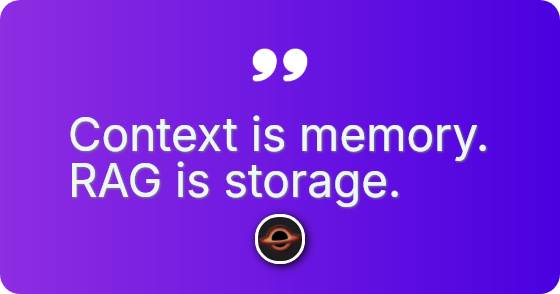
Even with models offering 1 million token windows, you rarely want to use the context window as your primary data store.
This is where Retrieval Augmented Generation, or RAG, comes in.
RAG is the library.
The context window is the desk.
You store gigabytes of data in a vector database (the library).
When a user asks a question, your system searches the library for the relevant page.
You pull that specific page out and place it on the desk (the context window).
The model then reads that page and answers the question.
Comparing the two approaches helps clarify the role of the context window:
- Context Window: Expensive, transient, limited capacity. Good for active analysis and reasoning on specific data.
- RAG: Cheap, permanent, unlimited capacity. Good for storage and retrieval.
Your engineering challenge is usually figuring out the most efficient way to move data from RAG into the Context Window without overflowing it or driving up costs.
Scenarios Where Size Matters
#There are specific business cases where the size of this window makes or breaks the product.
Complex Coding Assistants
If you are building a tool to help developers write code, context is everything.
Code files reference other code files.
To understand a function in file A, the model might need to see the definition in file B.
A small context window limits the tool to working on small snippets.
A large context window allows the AI to understand the architecture of the whole project.
Legal and Financial Analysis
Suppose you are building a tool to audit agreements.
A contract might define a term on page 2 and reference it on page 80.
If the window is too small, the model forgets the definition by the time it reaches the reference.
This leads to hallucinations or incorrect analysis.
Here, a massive context window provides a competitive advantage in accuracy.
Conversational Agents
For customer support bots, context determines how long the bot remembers the conversation.
With a small window, the bot might ask the user for their order number three times because it keeps sliding out of memory.
With a sufficient window, the bot maintains coherence throughout a long, complex troubleshooting session.
The Unknowns of Large Contexts
#We are currently seeing a race to increase context window sizes.
Some models now boast windows that can fit multiple novels.
However, this brings up questions we still do not have perfect answers for.
Does accuracy degrade as the window fills up?
Research suggests a “lost in the middle” phenomenon.
Models are good at remembering what is at the very beginning and very end of the prompt.
They sometimes struggle to recall details buried in the middle of a massive block of text.
Founders need to test this.
Just because you can fit the data in does not mean the model will effectively use it.
We also do not know how pricing models will shift.
Will context become commoditized and cheap?
Or will high-quality, long-context reasoning remain a premium feature?
This uncertainty makes long-term architectural planning difficult.
You must build with modularity in mind.
The context window is the constraint today.
It is the box you have to work within.
Mastering how to pack that box efficiently is what separates a working prototype from a scalable business.