


Building hardware is notoriously difficult. Unlike software, where a bug might mean a quick patch deployment, a flaw in hardware development can result in destroyed prototypes, safety hazards, or expensive recalls.
Founders entering the space of robotics, automotive tech, medtech, or any field involving complex embedded systems eventually hit a wall.
You cannot test everything in the real world immediately. It is too dangerous or too expensive.
This is where Hardware-in-the-Loop, often abbreviated as HIL, becomes a critical concept to understand.
HIL is a technique used to test and develop complex real-time embedded systems. It acts as a bridge between pure computer simulation and actual physical testing.
At its core, HIL simulation involves taking the actual controller you plan to use (the hardware) and connecting it to a computer that simulates the rest of the physical system (the plant). The controller believes it is operating a real machine, but it is actually interacting with a mathematical model.
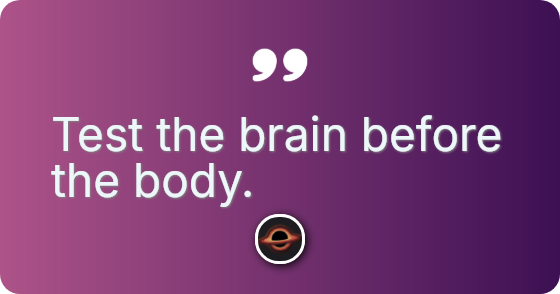
This allows engineers to test the brain of the product before the body is even built.
The Mechanics of HIL Simulation
#To understand how this works, you have to look at the feedback loop. In a deployed product, your embedded system (like an Electronic Control Unit or ECU) reads data from sensors, processes that data, and sends commands to actuators.
In a HIL setup, those sensors and actuators do not exist physically.
A real-time simulator generates the signals that the sensors would usually provide. The ECU reads these fake signals, makes a decision, and outputs a command.
The simulator captures that command and updates the mathematical model of the physical system instantly. This cycle happens in real-time.
This distinction of real-time is vital.
If the simulator is slower than the real world, the controller might detect a fault or fail to react correctly. The simulation must match the timing of the physical world exactly for the test to be valid.
This setup allows for rigorous testing of the controller. You can push the system to limits that would be impossible to test safely in a physical prototype.
HIL vs. SIL vs. PIL
#It is easy to get lost in the acronyms of testing. You might hear about Software-in-the-Loop (SIL) or Processor-in-the-Loop (PIL) and wonder how they differ from HIL.
Think of it as a spectrum of reality.
Software-in-the-Loop (SIL): This is pure simulation. The code that will eventually run on the hardware is compiled to run on a standard desktop computer. It interacts with a software model of the physical system. There is no specialized hardware involved here. It is fast and cheap but ignores the quirks of the actual processor.
Processor-in-the-Loop (PIL): The code runs on the target processor or a similar architecture, but the communication with the simulation is not necessarily real-time. This helps verify that the code compiles and runs correctly on the target architecture.
Hardware-in-the-Loop (HIL): The code runs on the actual final hardware controller. It interacts with the simulation via real electrical input and output (I/O) channels. This introduces the reality of electrical noise, latency, and interface issues. It is the closest you can get to the real world without moving the actual physical machine.
Why Startups Should Utilize HIL
#
For a startup founder, resource allocation is everything. HIL setups can be expensive. They require specialized real-time computers and interface boards.
So why would a cash-strapped startup invest in this?
It comes down to risk mitigation and development speed.
Building physical prototypes is slow. If you have to wait for a mechanical team to fabricate a new drone frame before you can test the flight controller, your software team is sitting idle. HIL allows the software and electrical teams to validate their work while the mechanical team is still welding or 3D printing.
It also allows for fault injection.
Imagine you are building an autonomous vehicle. You need to know what happens if a wheel speed sensor fails while driving at 60 miles per hour.
You cannot easily or safely cut a wire on a test track to find out.
With HIL, you simply tell the simulator to stop sending the speed signal. You can verify if your controller handles the failure gracefully or if it causes a catastrophe. You can run this test a thousand times in an afternoon without ever risking a driver or a vehicle.
Scenarios for Implementation
#Deciding when to implement HIL depends on the complexity of your product.
If you are building a simple consumer IoT device like a smart toaster, HIL might be overkill. Standard bench testing is likely sufficient.
However, consider these scenarios where HIL is indispensable:
- Aerospace: You cannot test an autopilot system on a real plane until you are absolutely certain it works. HIL is mandatory for certification.
- Automotive: Modern cars have dozens of ECUs. HIL allows manufacturers to test how the braking system interacts with the engine control unit before the car is assembled.
- Power Systems: If you are building inverters for a solar grid, you cannot risk blowing up the grid during testing. HIL allows you to simulate grid faults safely.
- Medical Devices: For devices like pacemakers or surgical robots, the cost of failure is human life. Extensive HIL testing ensures reliability under every conceivable condition.
The Trade-offs and Unknowns
#While HIL is powerful, it is not a silver bullet. It introduces its own set of challenges that a founder must navigate.
The primary challenge is the fidelity of the plant model.
Your test results are only as good as the simulation of the physical world. If your mathematical model of the drone’s aerodynamics is flawed, your HIL tests will pass, but the real drone might still crash.
How much time should your team spend refining the model versus building the product?
There is also the complexity of the interface. Connecting a real controller to a simulator often requires custom wiring harnesses and signal conditioning. This takes time and specialized talent.
Finally, there is the question of coverage. HIL is great for testing the controller, but it tells you nothing about the durability of the mechanical parts. It will not tell you if your motor will overheat or if a structural arm will snap under load.
Founders must ask themselves: what specific risks are we trying to burn down?
If the risk is in the logic and the control algorithms, HIL is the answer. If the risk is in the material science or mechanical integrity, HIL will not help you.
By understanding HIL, you move from guessing if your system works to knowing how it reacts. It allows you to fail safely in the lab so you can succeed in the field.