


In electrical engineering and science, Signal-to-Noise Ratio (SNR) is a measurement used to compare the level of a desired signal to the level of background noise. It is calculated as a ratio of signal power to noise power. A ratio higher than 1:1 indicates more signal than noise. A ratio lower than that means the noise is overpowering the information you are trying to receive.
When you are building a startup, you are essentially building a complex machine that processes information. You operate in an environment of extreme uncertainty. You are constantly bombarded with data points, opinions, market shifts, and internal operational friction.
Applying the concept of SNR to your business is not just a metaphor. It is a necessary framework for survival. It provides a way to quantify the quality of the information you use to make decisions. If your SNR is low, you are guessing. If your SNR is high, you are executing.
Founders often feel overwhelmed not because they lack information, but because they cannot distinguish the critical data from the irrelevant static. Understanding how to define, measure, and improve this ratio is a fundamental skill in navigating the early stages of a company.
Defining the Variables in a Startup Context
#To apply this concept, we must first define what constitutes the signal and what constitutes the noise. This definition changes depending on the specific function of the business you are analyzing, but the core principles remain the same.
The Signal is the truth. It is the information that directly correlates with the health, growth, and reality of your business. It is actionable. It is the metric that, if moved, actually changes your runway or your product trajectory.
The Noise is everything else. It is the data that mimics the signal but lacks substance. It is the vanity metric that looks good on a slide deck but does not pay the bills. It is the unsolicited advice from people who have never built what you are building. It is the fluctuation in daily traffic that has no statistical significance.
Distinguishing between the two is difficult because noise often presents itself as urgent. A furious email from a non-paying user feels like a signal. However, if your business model is B2B enterprise sales, that email is actually noise. Reacting to it consumes resources that should be spent on the signal coming from your paying contracts.
SNR in Customer Feedback and Product Development
#One of the most critical areas to monitor your SNR is during the product-market fit phase. You are soliciting feedback from everyone. You want to know what features to build and what bugs to fix.
High Signal feedback comes from your Ideal Customer Profile (ICP). These are the users who experience the pain point you are solving most acutely and have the budget to pay for it. When they speak, it correlates directly to revenue and retention.
High Noise feedback comes from users who are adjacent to your market but not in it. They might ask for features that pull your product in a direction that serves a niche you do not intend to monetize. If you listen to everyone, your product becomes a jagged, incoherent tool. This is a classic low SNR result.
Consider the volume of feedback channels. If you have an open public forum for feature requests, the noise floor is naturally high. You get spam, duplicate requests, and ideas from casual passersby. If you have a closed customer advisory board, the volume is lower, but the signal is incredibly high.
Founders must ask themselves if they are optimizing for volume of data or quality of insight. Why do we feel safer with more data points even if they dilute the truth? This is a question worth exploring as you design your feedback loops.
Comparing SNR to Vanity Metrics
#It is helpful to contrast SNR with the concept of vanity metrics to understand the distinction. Vanity metrics are often the result of failing to filter for noise.
For example, total registered users is a common metric. On the surface, it looks like a signal of growth. However, if 80 percent of those users signed up once and never returned, the metric is mostly noise. It masks the reality of your retention problem.
Active usage or Daily Active Users (DAU) is a metric with a higher SNR. It filters out the noise of dead accounts and focuses on the signal of engagement. Revenue is perhaps the metric with the highest possible SNR. It is difficult to fake money in the bank. It cuts through the noise of “intent to buy” and validates the value exchange.
When you review your weekly KPIs, look at each number and ask about the ratio. How much of this number is fluff? How much variance in this number is just random noise versus a result of our actions? If you cannot answer that, you may be steering the ship based on random waves rather than the lighthouse.
Operational SNR and Team Communication
#As your team grows, the noise floor naturally rises. In a two-person company, communication is instant and high-signal. In a fifty-person company, the sheer volume of Slack messages, emails, and meetings creates a massive amount of background static.
Operational noise looks like meetings without agendas. It looks like “FYI” emails sent to the whole company. It looks like debating the color of a button for three hours.
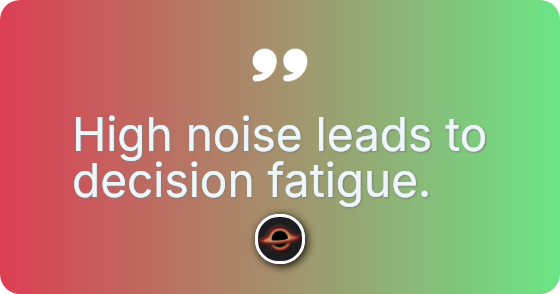
A low operational SNR leads to decision fatigue. The team spends more energy filtering information than acting on it. This is why small, autonomous teams often move faster than large organizations. Their SNR is naturally higher because there are fewer nodes generating noise.
You have to implement filters to improve this. This might mean enforcing strict documentation standards or limiting the number of people in decision-making meetings. It is not about silencing the team. It is about tuning the frequency so the important messages are heard clearly.
Navigating the Unknowns
#While we can define signal and noise, there are significant unknowns that every founder must grapple with. The most dangerous is the false positive. This happens when noise looks exactly like a signal.
A sudden spike in sales might look like market validation (signal). But it could be a result of a one-time external event or a bot attack (noise). If you scale your infrastructure based on that spike, you might burn your runway on a ghost.
How do we differentiate a weak signal from noise? Sometimes a trend starts as a very faint anomaly. If we filter too aggressively, we might miss the early indicators of a market shift or a new use case for our product.
There is also the question of bias. We tend to identify information that confirms our beliefs as signal and information that challenges us as noise. This confirmation bias artificially inflates our perceived SNR but actually blinds us to reality.
We must remain skeptical of our own filters. Are we tuning out the warnings because they are uncomfortable? Are we amplifying the praise because it feels good?
To build something that lasts, you must be relentless about hygiene in your information diet. You cannot afford to react to everything. You must develop the discipline to let the noise pass you by without flinching, so you are ready to act decisively when the true signal comes through.