


It is usually around 2:00 AM when the equation stops making sense.
You are lying in bed and staring at the ceiling while your partner sleeps beside you. The business had a good week. Revenue is up and the product roadmap is finally looking coherent. Yet there is a distinct heaviness in your chest that data sets and KPI dashboards cannot explain.
You have likely been told that entrepreneurship is a lonely road.
But that is not entirely accurate.
The road is actually crowded. It is crowded with conflicting demands, unspoken expectations, and a constant negotiation between who you are as a founder and who you are as a human being. The loneliness does not come from solitude. It comes from the inability to translate the pressure you feel into a language the people around you can understand.
We need to look at the founder’s life not as a hero’s journey but as a complex system. Systems fail when load exceeds capacity. Systems fail when resources are misallocated.
So how do we engineer this system to withstand the load?
The Geometry of Relationships
#There is a prevailing myth that you can compartmentalize your life. You have your work box and you have your family box. You are told to keep them separate to maintain sanity.
This is physically impossible.
Your startup is not a job. It is a living, breathing consumer of energy. It has moods. It has crises. It demands attention at inconvenient times. When you try to hide this from your family or partner, you create a vacuum of information. They feel the stress radiating off you but have no context for it.
We have to change the geometry of the situation.
Instead of viewing it as You versus Your Family versus The Startup, we need to introduce a new framework. The startup acts like a third person in the relationship. It is an entity that requires resources and attention, much like a dependent.

The Third Entity (Family & Startup)
When we acknowledge the business as a “Third Entity,” we stop fighting it and start managing it. We can look at our partner and say that the Third Entity is acting up today. It depersonalizes the conflict.
This allows for a logical discussion about resource allocation. How much time does the entity get this week? How much emotional bandwidth are we donating to it?
This shift moves the conversation from “You work too much” to “This entity is demanding too much.” It is a subtle semantic shift that changes the entire operational dynamic of a household.
The Physics of Ambition
#Once we stabilize the external relationships, we run into a harder problem.
The internal conflict.
There is a specific engine that drives founders. It is a mixture of dissatisfaction with the status quo and a hunger for improvement. We call this ambition. It is the fuel that allows you to push through rejection and failure.
But that same fuel is corrosive.
If you are constantly hungry for more, you are by definition never satisfied with what you have. This creates a state of perpetual psychological motion. You achieve a goal and the dopamine hit lasts for seconds before the brain re-centers on the next problem.
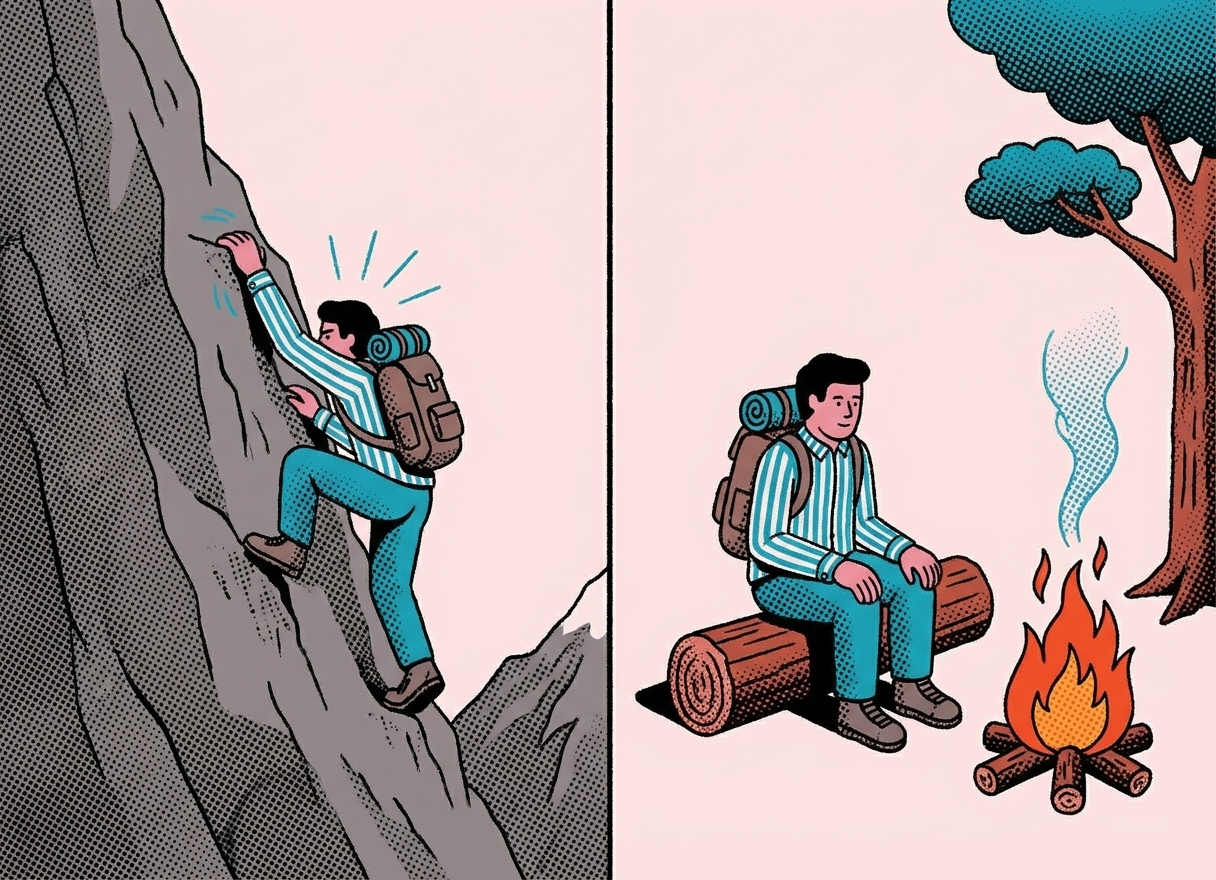
This paradox is difficult to navigate. If you kill the ambition, the business stalls. If you let the ambition run wild, you destroy your peace.
The solution requires us to look at ambition as a tool rather than a personality trait. It is a lever you pull when you need growth. It is not a state of being you must inhabit twenty four hours a day.
We have to ask ourselves a difficult question. Can we learn to be content with the present while still planning aggressively for the future? The data suggests that founders who can decouple their self worth from their growth metrics make clearer decisions. They operate out of strategy rather than anxiety.
The Economics of Survival
#Let us talk about resources.
Specifically money.
There is a narrative in the startup ecosystem that praises the starving founder. You are supposed to eat ramen and sleep on the floor to prove your dedication. Investors often implicitly encourage this behavior because it extends their runway.
Biologically speaking, this is a disaster.
Financial stress triggers the same centers in the brain as physical pain. When you are worried about making rent or buying groceries, your cognitive bandwidth shrinks. You lose the ability to do high level strategic thinking because your brain is locked in survival mode.

Paying yourself a livable wage is not an act of selfishness. It is a risk management strategy for the business. The company needs a CEO who can think clearly.
If you are distracted by personal insolvency, you are a liability to the organization. We need to reject the martyrdom of poverty. It does not make you a better founder. It just makes you a tired one.
Structural Integrity and Burnout
#The final variable in our equation is endurance.
Most advice on burnout focuses on symptom management. You are told to take a vacation. You are told to meditate. You are told to disconnect for a weekend.
These are temporary fixes for structural problems.
If you take a week off but return to the same broken processes and overwhelming workload, the burnout returns within forty eight hours. The vacation did not fix the machine. It just paused it.

We need to look at structural solutions. This means designing the business so it does not require your constant input to survive. It means building redundancy into the team. It means creating documentation that allows others to make decisions without you.
Burnout is usually a sign that you have become a single point of failure in your own system. The goal is not to escape the work. The goal is to design the work so that it is sustainable over a decade.
Solving the Equation
#We started with the idea that the founder’s life is a complex system.
We have looked at the variables.
We have the Third Entity of the business that impacts our relationships. We have the internal Ambition Paradox that drives us but threatens our peace. We have the economic reality of the Founder’s Salary. And we have the structural necessity of building systems to prevent burnout.
There is no perfect solution to this equation.
You cannot maximize every variable simultaneously. There will be seasons where the business takes more than it gives. There will be seasons where your family requires you to dial back the ambition.
The error most founders make is thinking they can brute force their way through these contradictions. They think if they just work harder, the math will eventually work out.
It won’t.
The only way to survive is to be intentional about the trade offs. You must look at the cost of your decisions not just in dollars, but in relational capital and cognitive load.
What variable are you optimizing for today?