


You remember the exact moment you realized you could not do it alone.
It was probably late at night. You were likely staring at a customer support ticket while simultaneously trying to fix a bug in the code and wondering if you remembered to pay the server bill. You had hit the physiological limit of one human being.
Up until that point, you were the engine. You were the marketing department, the sales team, the product lead, and the janitor. There is a certain purity to that phase. You have total control. You have zero communication overhead because all the information lives in your own head.
But a business that relies entirely on the output of one person is not a business. It is a job with high overhead.
To build something that lasts, you have to build a team. This sounds simple on paper. In practice, it is one of the most complex engineering challenges you will face. You are not just adding labor. You are adding variables.
How do you move from a solo operation to a functioning organization without destroying the very thing you built?
The Psychological Barrier of the First Hire
#Most founders start by hiring contractors. It is safe. It is transactional. You pay for a result, and you get a result. If it does not work out, you end the contract.
But there comes a time when a contractor is not enough. You need buy-in. You need someone whose livelihood depends on the success of the mission. You need an employee.
The first hire is rarely about skill alone. It is about trust. You are handing over a piece of your baby to a stranger.

The First Stranger: Transitioning from Contractors to Your First Real Hire
This transition brings immediate friction. You have to set up payroll. You have to deal with taxes. You have to explain things that you have done intuitively for years.
The goal of the first hire is not just to offload tasks. It is to prove that the business can exist outside of your own direct action. It is the first step in validating the company as a separate entity.
The Trap of Fake Delegation
#Once you have the person in the seat, you run into the next wall.
You give them work. They do it wrong. You fix it. You tell yourself it is faster to just do it yourself.
This is a failure of delegation. But more specifically, it is often a confusion between delegation and abdication. Abdication is when you throw a task over the wall and hope it gets done. Delegation is when you build a system for the task to be completed and monitor the output.

Delegation vs. Abdication: The Subtle Art of Losing Control
If you find yourself constantly taking work back from your team, you have not actually hired anyone. You are just paying for an audience while you work.
True delegation requires you to document your intuition. You have to turn your “gut feeling” into a checklist or a standard operating procedure. This is tedious. It feels like it slows you down. But it is the only way to multiply your output.
The Painful Shift to Specialization
#In the beginning, you hire generalists. You hire people who can write code in the morning, answer support tickets at lunch, and write blog posts in the afternoon. These people are essential for survival. They are the Swiss Army Knives of your startup.
But as you scale, the generalist becomes a liability.
You reach a point where you do not need someone who is “okay” at marketing. You need a killer who understands attribution modeling and CAC ratios. You do not need a full stack developer. You need a database architect.
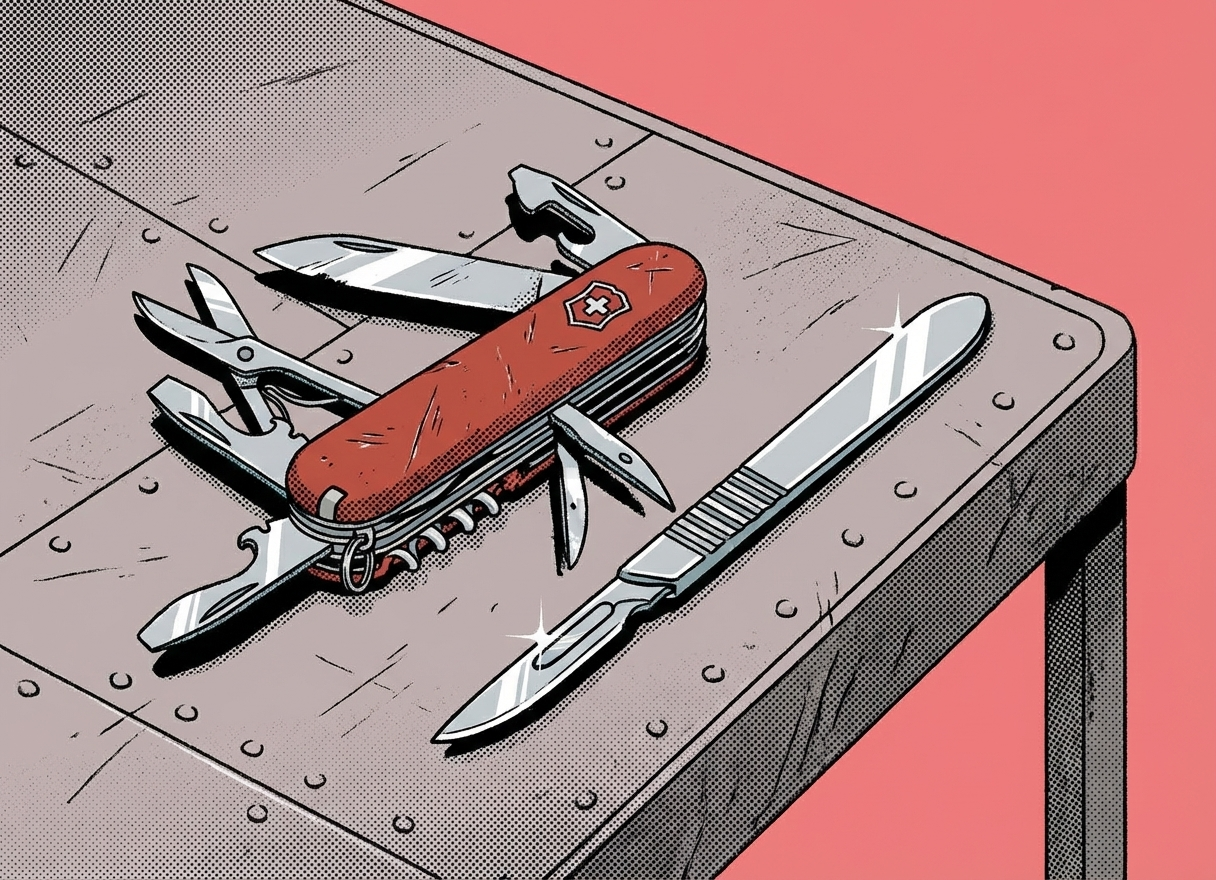
The Specialist Shift: Replacing the Generalists Who Got You Here
This is one of the most emotionally difficult phases for a founder. You often have to replace the people who sat in the trenches with you. The loyalty you feel toward them conflicts with the needs of the business.
However, a professional sports team does not keep a player on the field just because they are nice. They play the best athlete for the position. Your business requires the same discipline if you want to compete at a high level.
Building Culture Without Capital
#As the headcount grows, you lose the ability to control behavior through direct oversight. You cannot watch everyone all the time.
This is where culture comes in.
Silicon Valley has convinced us that culture is about ping pong tables, free lunches, and nap pods. This is marketing, not culture.
Culture is the set of unwritten rules that dictate how people behave when you are not in the room. It is how the team handles a crisis. It is how they treat a customer who is asking for a refund.

Culture on a Shoestring: Building a Tribe Without the Free Lunch
You do not need a budget to build culture. You need standards. You need to clearly articulate what you value and, more importantly, what you will not tolerate.
If you tolerate high performance jerks, your culture is toxic, regardless of how much free kombucha you have on tap. If you celebrate transparency, you have to be transparent even when the news is bad.
Moving from Updates to Coaching
#Finally, your role shifts entirely. You are no longer a doer. You are a manager.
Most founders are terrible managers. We default to asking “Did you do the thing?” and “When will the thing be done?” This turns your meetings into status updates.
Status updates can be an email. They do not need to be a meeting.
The most high leverage tool you have as a leader is the one on one meeting. But it has to be structured correctly.

The One-on-One: Moving from Status Updates to Strategic Coaching
These sessions should be about unblocking. They should be about career trajectory. They should be about psychological safety. You are there to clear the path so your high priced specialists can run at full speed.
If you are spending your one on ones reading a to do list, you are wasting money.
The New Machine
#When you look back at this progression, you see a distinct evolution.
You started as a solo artist. You moved to a band of generalists. You evolved into an orchestra of specialists. And now, you are the conductor.
The music is different. It is more complex. It requires more coordination. But the volume and the impact are infinitely higher than what you could produce on your own.
The question is no longer “How much work can I do?”
The question is “How well can I build the machine that does the work?”