
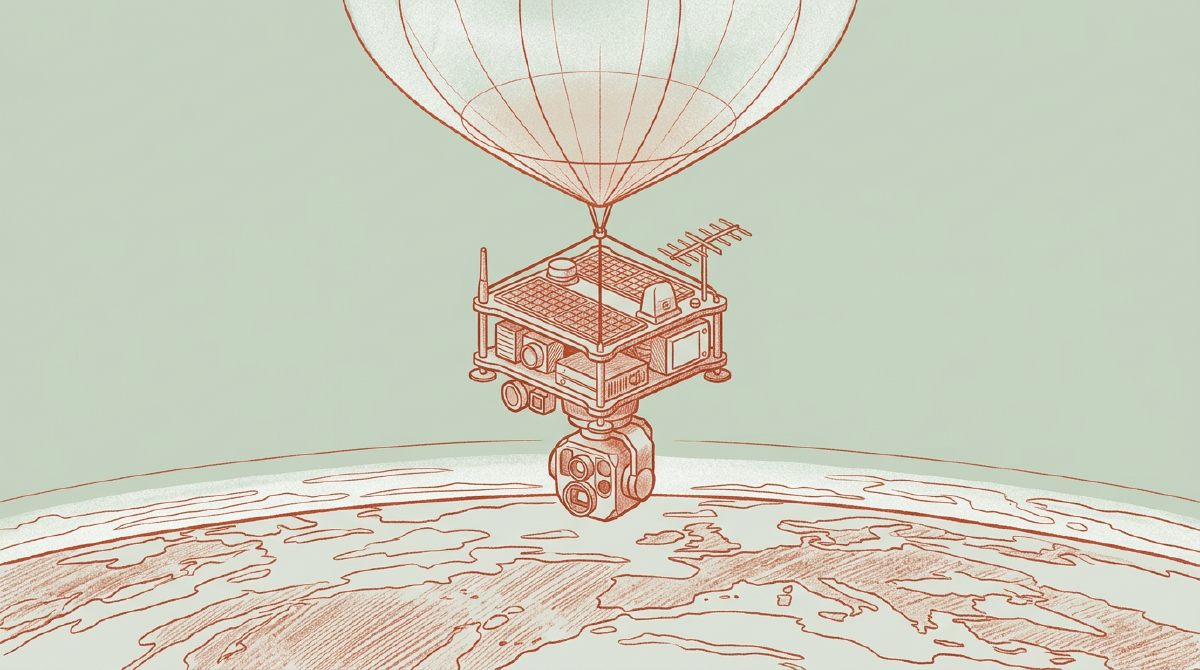

Building a business often requires finding a gap in the market that others have overlooked because it seemed too difficult to manage. In the world of geospatial data, that gap exists between the high altitude of satellites and the low altitude of airplanes and drones. Satellites can cover the whole earth but their resolution is often limited by the vast distance of space. Airplanes provide great detail but are expensive to operate and cannot scale to cover entire countries efficiently. Near Space Labs addresses this specific problem by operating in the stratosphere. They have developed a way to capture high resolution imagery that is both frequent and affordable for a wide variety of users.
The core of the solution lies in a proprietary robotic platform that functions at an altitude of about 60,000 to 80,000 feet. This is far above commercial air traffic but much closer to the ground than any orbiting satellite. By positioning their sensors in this specific layer of the atmosphere, the company can provide imagery that is sharp enough to see small details on the ground. This level of detail is necessary for industries that need to track changes in infrastructure or environment over time. The business model focuses on providing this data as a service, allowing other companies to build their own tools on top of these images. For an entrepreneur, this represents a classic example of identifying a physical frontier and building the technology needed to colonize it for data purposes.
The Team and the Robotic Platform
#The leadership at the helm of this operation includes CEO Rema Matevosyan and CTO Ignasi Lluch. Their backgrounds in aerospace and complex systems were instrumental in moving the company from a concept to a functional fleet of robots. The primary product is known as the Swift, which is a robotic flight system designed to carry sophisticated imaging sensors. Unlike traditional weather balloons that simply drift and are lost, these systems are designed for high frequency deployment and data recovery. The team had to solve significant engineering challenges related to extreme cold and low pressure environments to make this work. Building a hardware startup is notoriously difficult because the iteration cycles are much longer than in software development.
The market for this technology is diverse and spans several traditional industries that are currently undergoing digital transformations. Insurance companies use the data to assess property damage after major storms without having to send adjusters into dangerous areas immediately. Government agencies use it for urban planning and monitoring the health of public infrastructure like roads and bridges. Real estate developers and environmental conservationists also represent significant portions of the customer base. By providing a consistent stream of data, the company allows these organizations to make decisions based on what is happening right now rather than what happened months ago. The founders have positioned the company not just as a hardware manufacturer but as a critical infrastructure provider for the data economy.
Comparing Stratospheric Platforms to Existing Solutions
#When we look at the landscape of remote sensing, we see three primary tiers of data collection. The first tier consists of satellites which offer global coverage but often suffer from long revisit times and lower resolution. If a customer needs to see a specific city every day at 10 centimeter resolution, satellites usually cannot meet that requirement. The second tier involves fixed wing aircraft and drones which provide excellent resolution but have limited range. Pilots are expensive and drones have battery lives that restrict them to very small geographic areas. Near Space Labs occupies a unique third tier that combines the broad coverage of a satellite with the high resolution of an airplane.
The cost structure of their solution is also a point of differentiation in the current market. Traditional aerial photography requires a significant upfront investment in fuel, pilot hours, and maintenance for the aircraft. Satellites require hundreds of millions of dollars in launch costs before the first image is ever taken. The Swift platform is designed to be launched at a fraction of those costs, allowing for a much more flexible pricing model. This democratization of data is vital for smaller startups that may not have the budget for enterprise level satellite contracts. It allows a level of experimentation in the market that was previously impossible for most founders.
Practical Scenarios for Data Implementation
#
- Post disaster response where ground teams need immediate visual confirmation of road blockages or building integrity to deploy resources effectively.
- Supply chain monitoring for large scale construction projects where managers need to track the movement of materials across massive job sites daily.
- Agricultural yield forecasting that requires identifying crop stress at a granular level across thousands of acres without manual field inspections.
- Urban sprawl tracking for municipal governments that need to identify unauthorized construction or changes in land usage for tax purposes.
- Environmental monitoring of coastal erosion where small changes in the shoreline can indicate larger systemic risks to local infrastructure.
Each of these scenarios relies on the ability to see small changes over a short period of time. If the data is too old, it is useless for disaster response or construction management. If the resolution is too low, the agricultural or coastal changes might be missed entirely. By providing both speed and clarity, the company creates a product that fits into the existing workflows of these various industries. This alignment with user needs is a fundamental requirement for any startup trying to disrupt an established field.
Assessing Weaknesses and Strategic Adjustments
#No startup is without its flaws, and hardware companies operating in the atmosphere face a specific set of risks. One of the primary weaknesses is the dependence on weather conditions for launch and flight stability. Strong winds or severe storms in the lower atmosphere can delay operations or complicate the recovery of the sensor hardware. To address this, the company must invest heavily in meteorological modeling and autonomous flight algorithms. By predicting wind patterns more accurately, they can time their launches to maximize coverage while minimizing risk to the equipment. This turns a natural weakness into a technical challenge that can be solved through better software and data analysis.
Another potential weakness is the complexity of the recovery supply chain. Since the Swifts are not orbital, they eventually come back down and must be retrieved to maintain the hardware cycle. This requires a logistical network that can track and collect pods over wide geographic areas efficiently. If the cost of recovery becomes too high, it could erode the price advantage the company has over traditional aircraft. The solution likely involves further automation of the recovery process and perhaps regional hubs that reduce travel distance for recovery teams. As the company scales, these logistical hurdles will become as important as the imaging technology itself.
The Power of Movement in Unknown Environments
#There are still many unknowns regarding the long term regulation of stratospheric flight and the density of the market. Some might argue that waiting for clearer international laws or more stable helium prices would be the safer path. However, in the startup world, movement is almost always better than waiting for perfect information. Near Space Labs is moving by launching flights and gathering data today rather than debating the future of the stratosphere in a conference room. This bias for action allows them to learn from real world failures and successes which provides a level of insight that competitors cannot gain through theory alone.
Every launch provides more data points on how the hardware performs and how the market responds to the imagery. This feedback loop is the most valuable asset a startup has when navigating a complex environment. Critics may point to the risks of hardware loss or the volatility of the weather, but the act of doing creates its own momentum. Founders who focus on building and operating rather than just planning are the ones who eventually define the standards for their industry. The difficulty of the work is what creates the moat around the business, making it harder for others to follow without putting in the same level of effort. Near Space Labs continues to demonstrate that by solving the hard problems of the stratosphere, they are building something that is both solid and remarkably valuable.