
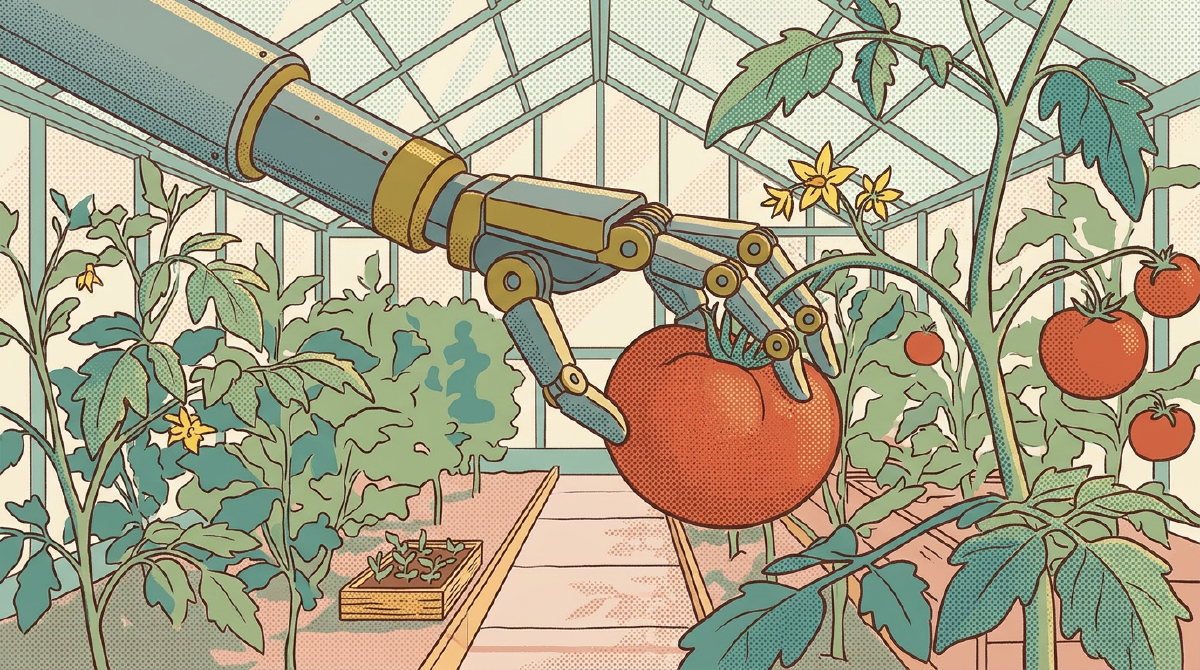

Building a company in the hardware space is a grueling process that requires a mix of engineering precision and operational endurance. At iambenschmidt, we often discuss the necessity of solving real problems rather than chasing trends. Agriculture is one of those sectors where the problems are tangible and the labor gaps are growing every year. Many founders look at software as the easy path, but the physical world still needs builders. Four Growers is a startup based in Pittsburgh that has decided to tackle the complexity of the physical world by automating the harvest.
The Robotic Solution for Greenhouse Harvesting
#The primary challenge Four Growers addresses is the extreme scarcity of labor within the greenhouse industry. Greenhouse farming, or controlled environment agriculture, allows for year-round production but relies heavily on human hands for delicate tasks. Harvesting tomatoes is particularly difficult because it requires identifying ripeness and handling the fruit without causing damage. The GR-100 is the flagship robotic harvester developed by the company to perform these tasks autonomously. It uses advanced computer vision to scan plants and determine which tomatoes are ready for the market.
Once a ripe tomato is identified, the robot uses a specialized picking head to remove the fruit from the vine. This process must be fast enough to compete with human speed while maintaining a high level of accuracy. The system is designed to work within the existing infrastructure of modern greenhouses. This means growers do not have to redesign their entire facility to accommodate the technology. By automating this single point of friction, the company allows growers to focus on crop health and yield optimization.
The robot does more than just pick fruit during its path through the greenhouse. It simultaneously collects data on every plant it encounters. This level of granular data is usually impossible to gather with manual labor alone. The robot can track growth rates, identify early signs of disease, and predict future yields. This transforms the harvester from a simple tool into a mobile sensor suite for the entire farm.
The Product Team and the Tomato Market
#The team behind this technology emerged from the robotics ecosystem in Pittsburgh, a city known for its deep roots in autonomous systems. Many of the core members have backgrounds from Carnegie Mellon University, which provides a strong foundation in computer vision and path planning. They have combined this technical expertise with a practical understanding of the agricultural world. Instead of staying in a lab, they have spent significant time inside commercial greenhouses to understand the environmental constraints. This proximity to the actual work site has allowed them to iterate on their hardware based on real world feedback.
Their primary focus is currently on the tomato market, which is a multi billion dollar global industry. Tomatoes are grown in vast quantities in greenhouses across North America and Europe. The specific characteristics of the market make it an ideal starting point for robotic harvesting.
- Tomato plants are typically grown in structured rows that robots can navigate easily.
- The fruit is visible and follows predictable patterns of ripeness.
- Labor costs for tomato harvesting represent a significant portion of total operating expenses.
- There is a high demand for consistency in the quality and maturity of the harvested fruit.
Beyond tomatoes, the market for greenhouse vegetables including cucumbers and peppers is also expanding rapidly. Consumers are increasingly demanding produce that is grown locally and without heavy pesticide use. Greenhouses provide the control needed for this, but they cannot function without a reliable workforce. Four Growers is positioning itself to be the underlying technology layer that makes this sustainable. As the team scales, they are looking at how their vision systems can be applied to other crops with similar harvesting needs.
Comparing Robotic Systems to Manual Labor
#When we look at the current state of the industry, the primary comparison for Four Growers is the traditional human harvesting crew. Manual labor has been the standard for centuries because the human hand and eye are incredibly versatile. Humans can navigate uneven terrain and make split second decisions about fruit quality. However, the human labor pool for agriculture is shrinking in many developed nations. This creates a volatile environment where a grower might not have enough staff to harvest a crop before it rots.
There are other robotic companies in the space, but many focus on outdoor broadacre farming. Indoor harvesting is a different challenge because of the tight spaces and the need for delicate handling. Compared to existing stationary automation in packing houses, a mobile harvester must deal with varying light conditions and biological obstacles. Four Growers focuses on the mobility and the integration into the greenhouse row. This specific focus on the “last mile” of the harvest sets them apart from more generalized agricultural tech firms.
Scenarios for Robotic Integration
#There are several specific scenarios where this technology provides the most immediate value to a business. In large scale commercial operations, the sheer volume of fruit makes manual management nearly impossible to track perfectly. A fleet of robots can be deployed to handle the bulk of the harvesting work during peak seasons. This allows the human staff to focus on more complex tasks like plant maintenance and pest management. It changes the role of the farm worker from a manual laborer to a robot supervisor.
Another scenario involves 24/7 harvesting schedules to meet tight shipping deadlines. Retailers often require produce to be delivered at specific times to ensure freshness on the shelves. A robot can harvest through the night so that the fruit is ready for the morning transport trucks. This level of operational flexibility is difficult to achieve with a human crew that prefers standard working hours. It also reduces the need for large on site housing facilities for seasonal workers.
- High labor cost regions where the minimum wage makes manual harvesting unprofitable.
- Areas with extreme seasonal labor shortages that threaten the harvest window.
- Facilities focusing on data driven agriculture to maximize every square foot of space.
- Greenhouses looking to reduce the risk of pathogen spread from human contact with plants.
Addressing Potential Weaknesses
#Every startup has weaknesses, especially when hardware is involved. One of the primary concerns for Four Growers is the upfront capital expenditure required for robotic systems. Small or mid sized growers may find it difficult to invest in a fleet of robots compared to paying seasonal wages. To address this, the company must look at various business models like Robotics as a Service. This allows growers to pay based on the volume of fruit harvested rather than buying the machine outright. Such a model lowers the barrier to entry and aligns the startup’s success with the grower’s yield.
Another challenge is the mechanical complexity and the potential for downtime. If a robot breaks down in the middle of a row, it can block operations and require specialized technicians to fix. The environment inside a greenhouse is humid and dusty, which is notoriously hard on electronics and moving parts. Four Growers must ensure their hardware is ruggedized and that they have a robust support network. They can address this by designing modular components that are easy for farm staff to swap out. Simplifying the maintenance process is just as important as the AI that drives the picking arm.
The Power of Movement over Debate
#In the world of startups, it is very easy to spend years debating the perfect sensor or the most efficient path algorithm. There are many critics who will point out that robots are still slower than humans or that the technology is too expensive. However, Four Growers is focused on the act of doing. They have deployed their systems in real environments and are collecting real world data. This movement is far more valuable than any theoretical debate about the future of farming.
Every hour the robot spends in the greenhouse provides insights that cannot be found in a research paper. They are learning about the specific ways tomato vines wrap around supports and how different varieties of tomatoes reflect light. This empirical knowledge builds a competitive moat that is difficult for others to replicate. It is the grit of hardware development that separates the builders from the dreamers. By choosing to move and iterate, they are solving the problems of today while preparing for the scale of tomorrow.
Aspiring founders should take note of this approach to business. You do not need a perfect solution to start; you need a solution that works in the field. The complexity of the real world will always provide more information than a boardroom meeting. Four Growers is a clear example of how staying focused on the practical needs of an industry can lead to a remarkable product. They are not just building a robot; they are building a more resilient food system. This journey shows that with enough work and a focus on the right problems, it is possible to build something that lasts.
Original content can be found at: https://fourgrowers.com/